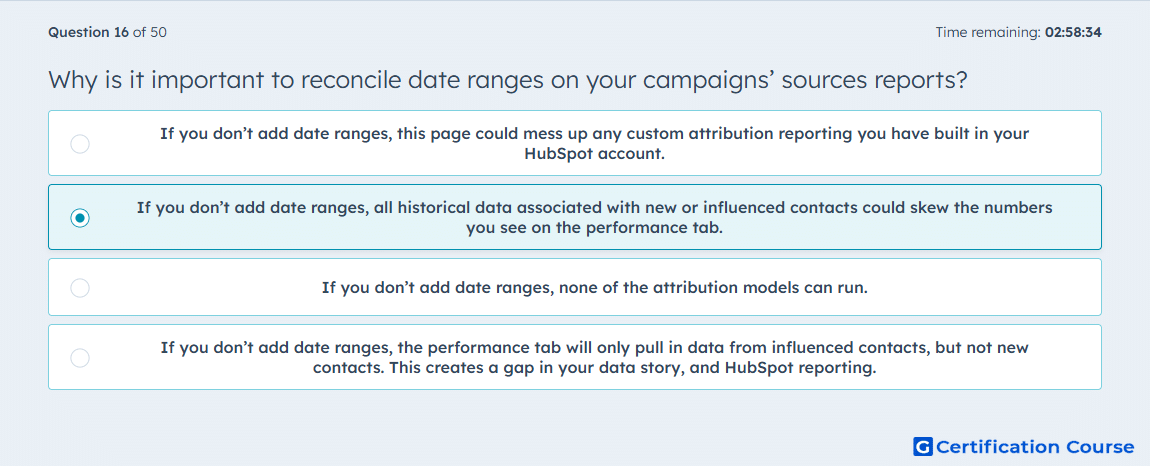
Question: Why is it important to reconcile date ranges on your campaigns’ sources reports?
- If you don’t add date ranges, this page could mess up any custom attribution reporting you have built in your HubSpot account.
- If you don’t add date ranges, all historical data associated with new or influenced contacts could skew the numbers you see on the performance tab.
- If you don’t add date ranges, none of the attribution models can run.
- If you don’t add date ranges, the performance tab will only pull in data from influenced contacts, but not new contacts. This creates a gap in your data story, and HubSpot reporting.
Explanation
Reconciling date ranges keeps campaigns reporting focused on the performance period being analyzed. Without date ranges, HubSpot can include historical activity tied to new or influenced contacts, which can distort the numbers on the performance tab. This matters because campaign reporting should reflect the relevant timeframe for the assets and contacts being reviewed. Accurate date alignment helps make source performance easier to interpret and compare.
Why the other options are incorrect
Custom attribution reporting is incorrect because missing campaign date ranges does not directly break custom attribution reporting.
Attribution models is incorrect because attribution models can still run without campaign date ranges.
Influenced contacts only is incorrect because the issue is skewed historical data, not the exclusion of new contacts.
Source for verification
https://knowledge.hubspot.com/campaigns/analyze-your-campaign-performance
The answer(s) to the question is highlighted in the BOLD text above. You can also find more questions and answers related to the exams on the "HubSpot Inbound Marketing Optimization" page.