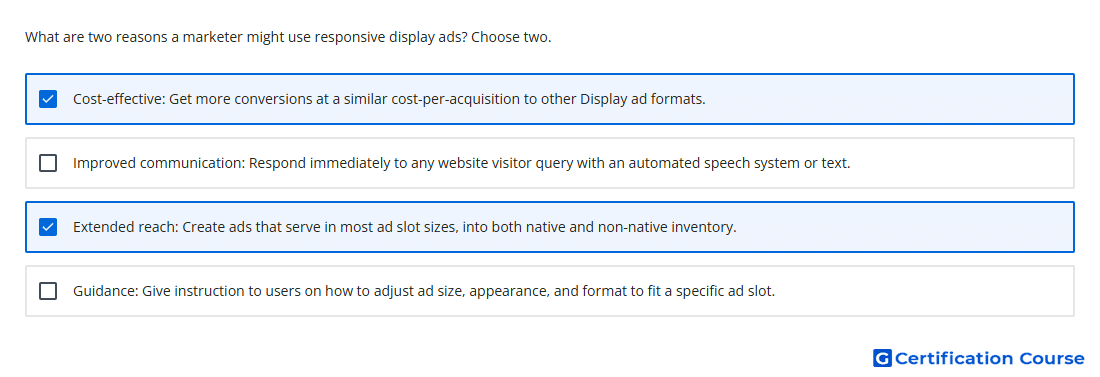
Question: What are two reasons a marketer might use responsive display ads? Choose two.
- Extended reach: Create ads that serve in most ad slot sizes, into both native and non-native inventory.
- Guidance: Give instruction to users on how to adjust ad size, appearance, and format to fit a specific ad slot.
- Improved communication: Respond immediately to any website visitor query with an automated speech system or text.
- Cost-effective: Get more conversions at a similar cost-per-acquisition to other Display ad formats.
Explanation
Responsive display ads leverage advanced machine learning to automatically combine uploaded assets (images, headlines, logos, videos, and descriptions) into optimal configurations at auction time. This dynamic assembly process allows the final advertisement to seamlessly adapt its size, appearance, and format to fit virtually any available space across the Google Display Network, including highly sought-after native inventory. This adaptability translates directly to extended reach, as the ads can serve in placements that static banners cannot. Furthermore, because the algorithm continuously tests and prioritizes the best-performing asset combinations, these ads efficiently drive higher conversion volumes while maintaining a cost-effective cost-per-acquisition (CPA).
Why the other options are incorrect
Guidance is incorrect because the dynamic resizing and formatting are handled entirely automatically by the platform's algorithms; the system does not instruct users or advertisers to make manual adjustments for specific slots.
Improved communication incorrectly describes the functionality of customer service chatbots or interactive messaging systems, whereas responsive display ads are strictly visual and text-based promotional banners.
Source for verification
https://support.google.com/google-ads/answer/6363750
The answer(s) to the question is highlighted in the BOLD text above. You can also find more questions and answers related to the exams on the "Google Ads Display Certification" page.