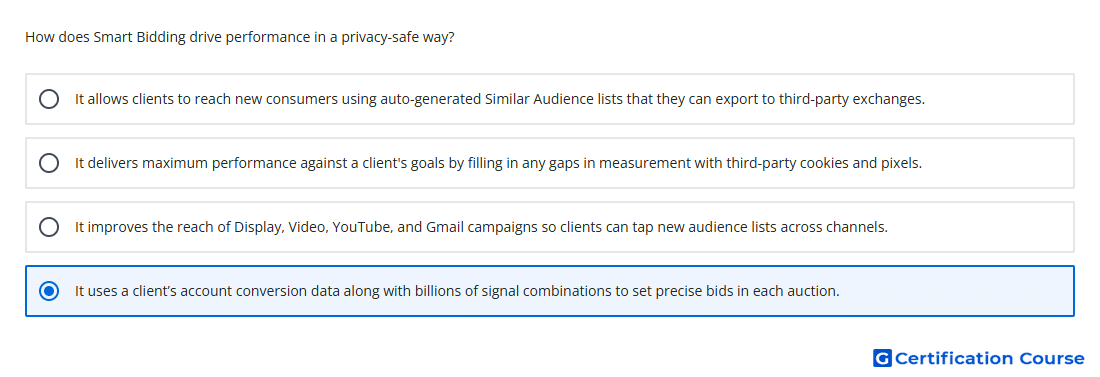
Question: How does Smart Bidding drive performance in a privacy-safe way?
- It improves the reach of Display, Video, YouTube, and Gmail campaigns so clients can tap new audience lists across channels.
- It delivers maximum performance against a client's goals by filling in any gaps in measurement with third-party cookies and pixels.
- It allows clients to reach new consumers using auto-generated Similar Audience lists that they can export to third-party exchanges.
- It uses a client’s account conversion data along with billions of signal combinations to set precise bids in each auction.
Explanation
Smart Bidding uses Google AI to optimize bids for conversions or conversion value in each auction. It combines the advertiser’s conversion data with many available signals to predict the likelihood and value of a conversion. Auction-time bidding allows bids to adjust dynamically based on each eligible auction’s context. This supports performance without relying on third-party cookie workarounds or exported user lists.
Why the other options are incorrect
Third-party cookies and pixels is incorrect because Smart Bidding is designed to optimize with privacy-safe signals, not fill gaps through third-party tracking.
Cross-channel audience reach is incorrect because broader reach across channels describes campaign delivery, not how Smart Bidding sets bids.
Similar Audience exports is incorrect because Smart Bidding does not export audience lists to third-party exchanges.
Source for verification
https://support.google.com/google-ads/answer/7065882
https://support.google.com/google-ads/answer/10964872
The answer(s) to the question is highlighted in the BOLD text above. You can also find more questions and answers related to the exams on the "Privacy for Agencies and Partners Certification" page.