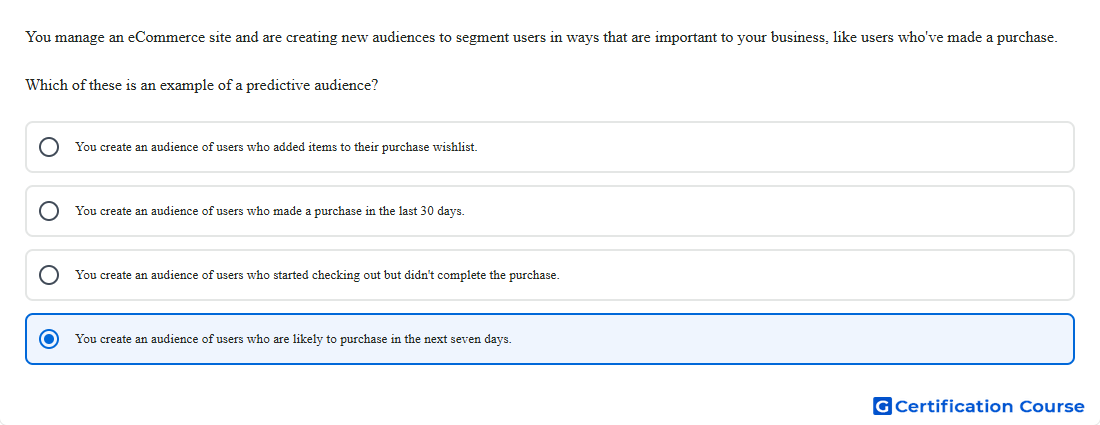
Question: You manage an eCommerce site and are creating new audiences to segment users in ways that are important to your business, like users who've made a purchase. Which of these is an example of a predictive audience?
- You create an audience of users who are likely to purchase in the next seven days
- You create an audience of users who added items to their purchase wishlist
- You create an audience of users who made a purchase in the last 30 days
- You create an audience of users who started checking out but didn't complete the purchase
Explanation
A predictive audience is built from predictive metrics generated by Google Analytics. Users who are likely to purchase in the next seven days match the Likely 7-day purchasers audience pattern. This audience relies on modeled purchase probability rather than only past behavior. It helps identify users with a predicted future action, which distinguishes it from rule-based audience examples.
Why the other options are incorrect
Wishlist users is incorrect because it is based on a completed event, not predicted future behavior.
Recent purchasers is incorrect because it is based on past purchase activity.
Checkout abandoners is incorrect because it is based on observed checkout behavior without a purchase.
Source for verification
https://support.google.com/analytics/answer/9805833
https://support.google.com/analytics/answer/9846734
The answer(s) to the question is highlighted in the BOLD text above. You can also find more questions and answers related to the exams on the "Google Analytics Certification" page.