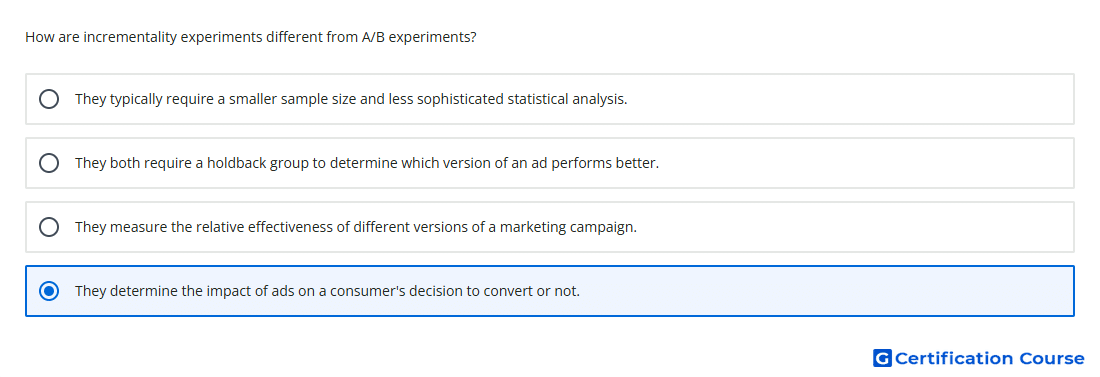
Question: How are incrementality experiments different from A/B experiments?
- They typically require a smaller sample size and less sophisticated statistical analysis.
- They both require a holdback group to determine which version of an ad performs better.
- They measure the relative effectiveness of different versions of a marketing campaign.
- They determine the impact of ads on a consumer's decision to convert or not.
Explanation
Incrementality experiments measure the causal effect of advertising by comparing exposed users with a control group that did not receive the ads. This shows whether conversions happened because of the ads or would have happened anyway. The focus is on net-new impact, not on choosing between creative or campaign versions. This makes incrementality useful for understanding true contribution to conversion outcomes.
Why the other options are incorrect
Holdback group is incorrect because incrementality testing typically depends on a control or holdback group.
Sample size is incorrect because incrementality experiments often require sufficient volume and statistical rigor.
Relative effectiveness describes A/B testing, not incrementality measurement.
Source for verification
https://support.google.com/google-ads/answer/9049373
https://support.google.com/google-ads/answer/17452156
The answer(s) to the question is highlighted in the BOLD text above. You can also find more questions and answers related to the exams on the "Google Ads - Measurement Certification" page.