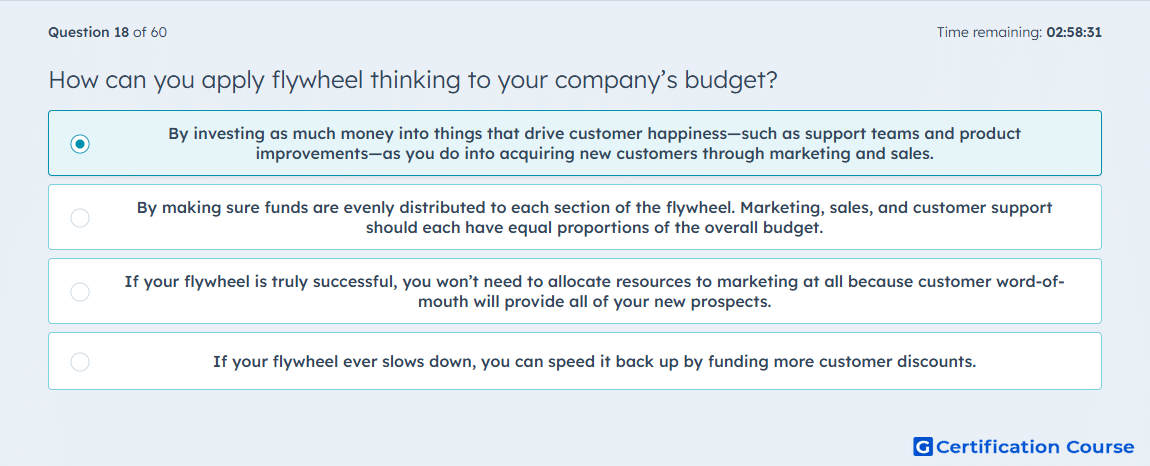
Question: How can you apply flywheel thinking to your company’s budget?
- By investing as much money into things that drive customer happiness—such as support teams and product improvements—as you do into acquiring new customers through marketing and sales.
- By making sure funds are evenly distributed to each section of the flywheel. Marketing, sales, and customer support should each have equal proportions of the overall budget.
- If your flywheel is truly successful, you won’t need to allocate resources to marketing at all because customer word-of-mouth will provide all of your new prospects.
- If your flywheel ever slows down, you can speed it back up by funding more customer discounts.
Explanation
HubSpot’s Empathize principle focuses on understanding the audience’s perspective before creating interactions. Trust grows when communication fits the person’s context instead of forcing a company-centered process. The buyer’s journey helps organize helpful content around how people move toward a decision. This reduces friction and makes engagement feel relevant, useful, and timely.
Why the other options are incorrect
experiment is not a HubSpot trust-building alignment category in the inbound methodology.
Source for verification
https://academy.hubspot.com/lessons/inbound-principles
https://academy.hubspot.com/lessons/buyers-journey
The answer(s) to the question is highlighted in the BOLD text above. You can also find more questions and answers related to the exams on the "HubSpot Inbound Certification" page.