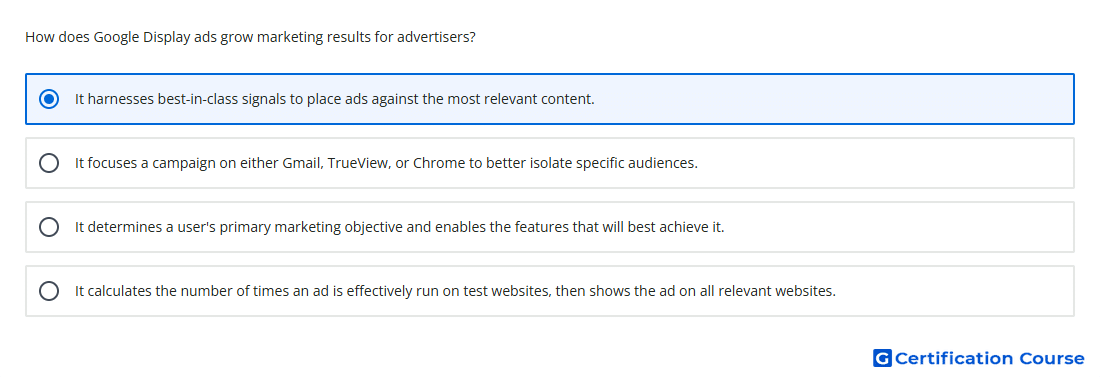
Question: How does Google Display ads grow marketing results for advertisers?
- It harnesses best-in-class signals to place ads against the most relevant content.
- It determines a user's primary marketing objective and enables the features that will best achieve it.
- It calculates the number of times an ad is effectively run on test websites, then shows the ad on all relevant websites.
- It focuses a campaign on either Gmail, TrueView, or Chrome to better isolate specific audiences.
Explanation
The Google Display Network leverages advanced machine learning to analyze immense amounts of real-time data across millions of websites and applications. By processing these extensive intent and behavioral signals, the system accurately predicts where an advertisement will generate the most meaningful engagement. This automated matching process ensures that promotional messaging appears alongside highly relevant content that aligns with the target audience's current interests. Consequently, advertisers achieve greater campaign efficiency by connecting with potential customers at the precise moment they are most likely to interact with the brand.
Why the other options are incorrect
Determining a primary marketing objective is a manual choice made by the advertiser during campaign creation rather than an automated platform mechanism.
Calculating runs on test websites is a fabricated concept, as the system does not utilize a sandbox testing environment prior to serving live impressions.
Focusing on either Gmail, TrueView, or Chrome incorrectly restricts the fundamental value of the network, which is designed to seamlessly distribute messaging across millions of diverse publisher placements simultaneously.
Source for verification
https://support.google.com/google-ads/answer/2404190
The answer(s) to the question is highlighted in the BOLD text above. You can also find more questions and answers related to the exams on the "Google Ads Display Certification" page.