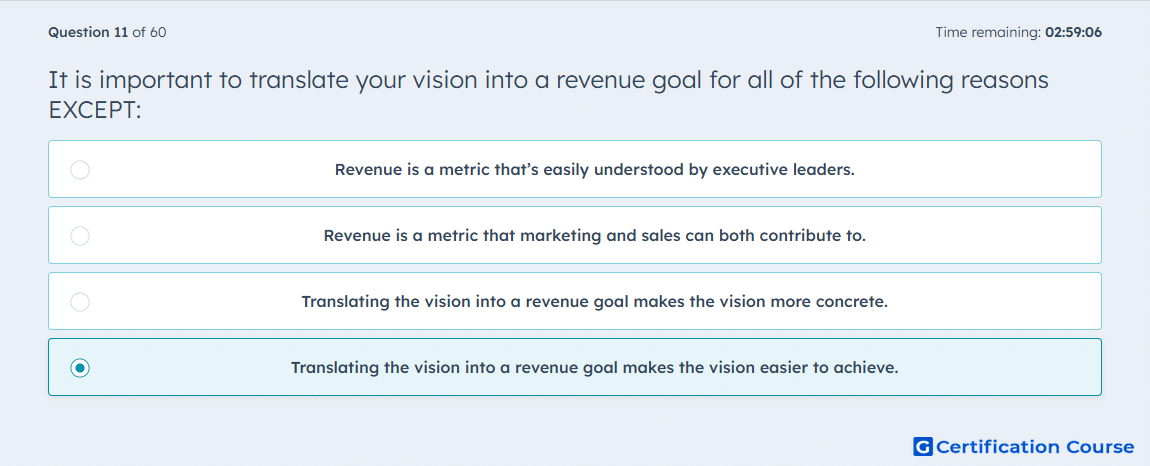
Question: It is important to translate your vision into a revenue goal for all of the following reasons EXCEPT:
- Revenue is a metric that’s easily understood by executive leaders.
- Revenue is a metric that marketing and sales can both contribute to.
- Translating the vision into a revenue goal makes the vision more concrete.
- Translating the vision into a revenue goal makes the vision easier to achieve.
Explanation
Translating a vision into a revenue goal provides a concrete metric that leadership can understand and aligns both marketing and sales efforts toward measurable outcomes. It clarifies how the vision connects to business impact without implying that the goal itself reduces the inherent challenge of achieving the vision. Revenue goals serve as a guide for execution and tracking performance, not a simplification of the vision’s difficulty. Metric alignment ensures teams focus on results that support long-term objectives.
Why the other options are incorrect
A) Revenue is understandable by executive leaders, making it an effective communication tool.
B) Both marketing and sales can directly influence revenue, enabling cross-team alignment.
C) A revenue goal makes the vision tangible and measurable for operational planning.
Source for verification
HubSpot Sales Enablement Metrics and Goals
The answer(s) to the question is highlighted in the BOLD text above. You can also find more questions and answers related to the exams on the "HubSpot Sales Enablement Certification" page.