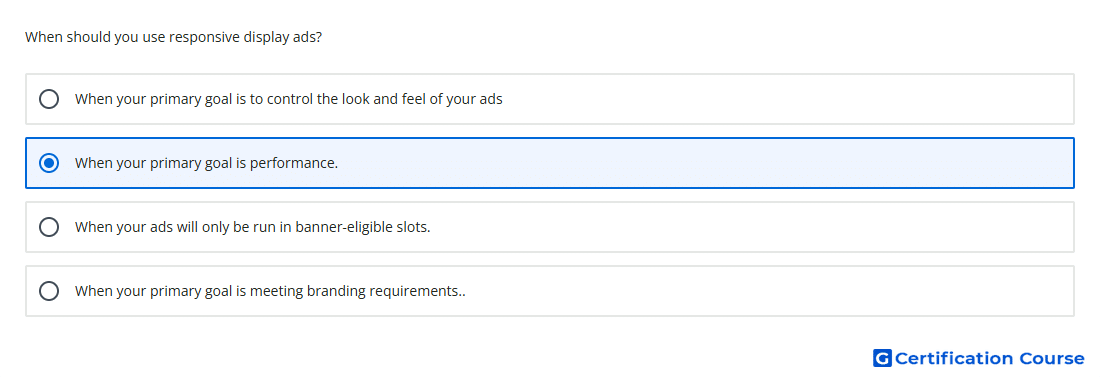
Question: When should you use responsive display ads?
- When your ads will only be run in banner-eligible slots.
- When your primary goal is to control the look and feel of your ads
- When your primary goal is performance.
- When your primary goal is meeting branding requirements..
Explanation
Responsive display ads utilize advanced machine learning algorithms to automatically assemble and test various uploaded assets (headlines, descriptions, images, and logos) at the exact moment of the ad auction. Because the system continuously evaluates these permutations and prioritizes serving the variations that generate the highest engagement or conversions, this format is explicitly designed to maximize overall campaign performance. The automation dynamically adjusts the layout to fit virtually any publisher space, prioritizing algorithmic efficiency and reach over strict design conformity.
Why the other options are incorrect
Running only in banner-eligible slots is incorrect because responsive display ads fluidly adapt to fit into native and text-based inventory, expanding well beyond standard traditional banner placements.
Controlling the look and feel is not the primary goal of this format, as advertisers must surrender exact layout control to the platform's automated assembly process.
Meeting branding requirements is best achieved through custom uploaded ads (like HTML5 or static images), which allow for strict adherence to corporate design guidelines without algorithmic interference.
Source for verification
https://support.google.com/google-ads/answer/6363750
The answer(s) to the question is highlighted in the BOLD text above. You can also find more questions and answers related to the exams on the "Google Ads Display Certification" page.