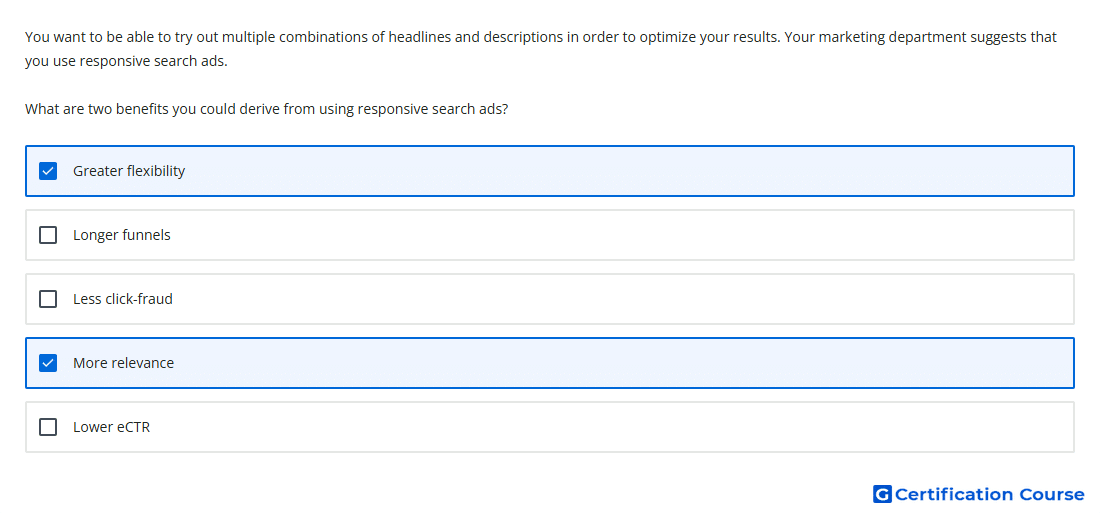
Question: You want to be able to try out multiple combinations of headlines and descriptions in order to optimize your results. Your marketing department suggests that you use responsive search ads. What are two benefits you could derive from using responsive search ads?
- Less click-fraud
- Longer funnels
- Lower eCTR
- More relevance
- Greater flexibility
Explanation
Responsive Search Ads (RSAs) fundamentally shift campaign creation from static, rigid text to dynamic, machine-learning-driven assembly. By supplying multiple text assets (up to 15 headlines and 4 descriptions), the system gains greater flexibility to construct an ad layout that physically adapts to various device screens, ensuring the message utilizes the maximum available space whether the user is on a mobile phone or a desktop monitor. Furthermore, the algorithmic engine continuously evaluates these text combinations against active, real-time search queries. This allows the system to instantly serve the specific combination of words that achieves more relevance to the searcher's exact intent, vastly outperforming the semantic limitations of a single, unchangeable ad.
Why the other options are incorrect
Less click-fraud is incorrect because automated ad assembly focuses entirely on optimizing the text displayed to the user, whereas fraud prevention relies on separate backend systemic security filters evaluating the validity of the traffic source.
Longer funnels is incorrect because ad copy variations are designed to improve immediate click-through rates and capture intent quickly, rather than intentionally elongating the multi-step journey a user takes to convert.
Lower eCTR (expected click-through rate) is incorrect because the explicit purpose of testing multiple highly-relevant variations is to systematically increase the likelihood of a user clicking, thus raising the eCTR metric.
Source for verification
https://support.google.com/google-ads/answer/7684791
The answer(s) to the question is highlighted in the BOLD text above. You can also find more questions and answers related to the exams on the "Google Ads Search Certification" page.