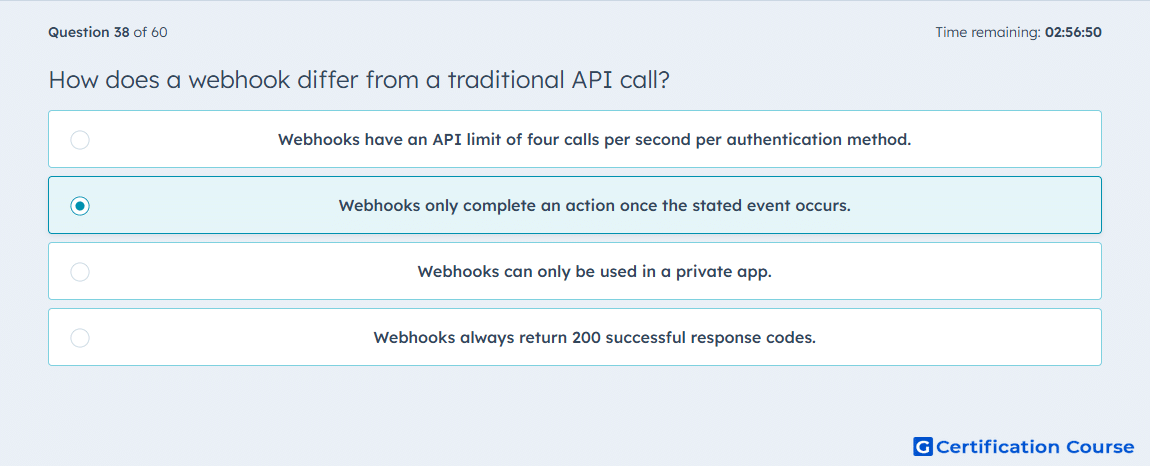
Question: How does a webhook differ from a traditional API call?
- Webhooks have an API limit of four calls per second per authentication method.
- Webhooks only complete an action once the stated event occurs.
- Webhooks can only be used in a private app.
- Webhooks always return 200 successful response codes.
Explanation
A webhook is event-driven, so the action happens only after a defined event occurs. In Amazon Ads integration design, this differs from a standard Amazon Ads API request, where an application directly calls an endpoint to retrieve or change data. Traditional API calls are request-based and happen when the application sends the request. Event-driven flows reduce repeated polling when the integration only needs to react to specific changes. This distinction helps control API usage and avoid unnecessary requests.
Why the other options are incorrect
API limit This describes a rate-limit rule, not the functional difference between webhooks and standard API calls.
Private app This is incorrect because webhook-style event handling is not defined by private app usage.
200 response codes This is incorrect because webhooks do not always return successful response codes.
Source for verification
https://advertising.amazon.com/API/docs/en-us/reference/api-overview
https://advertising.amazon.com/API/docs/en-us/reference/concepts/rate-limiting
The answer(s) to the question is highlighted in the BOLD text above. You can also find more questions and answers related to the exams on the "Integrating With HubSpot I: Foundations" page.