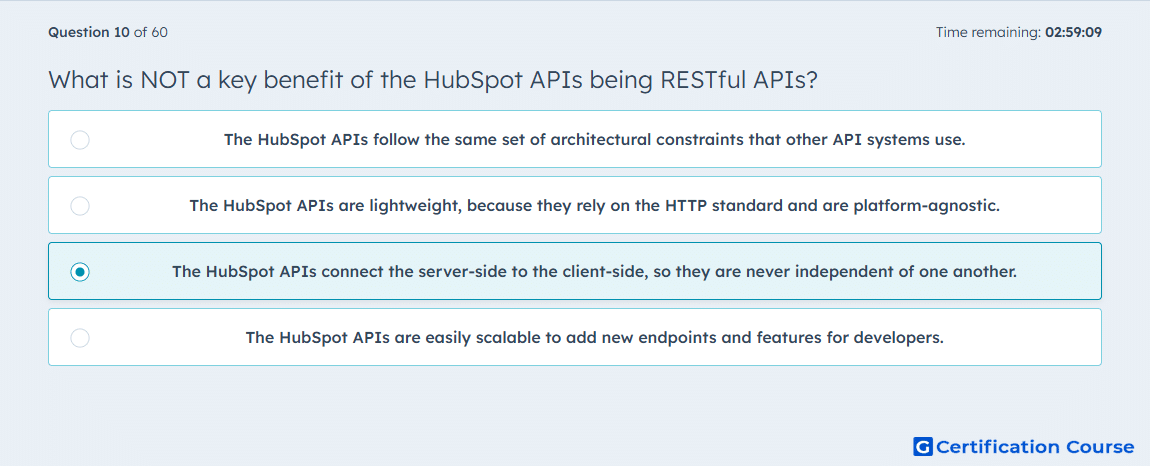
Question: What is NOT a key benefit of the HubSpot APIs being RESTful APIs?
- The HubSpot APIs follow the same set of architectural constraints that other API systems use.
- The HubSpot APIs are lightweight, because they rely on the HTTP standard and are platform-agnostic.
- The HubSpot APIs connect the server-side to the client-side, so they are never independent of one another.
- The HubSpot APIs are easily scalable to add new endpoints and features for developers.
Explanation
REST APIs are designed around independent client-server interaction, so the client and server are not tightly dependent on each other. RESTful APIs use standard HTTP methods and resource-based endpoints to keep requests predictable. This architecture supports platform-agnostic communication between systems. It also allows HubSpot to expand API resources without requiring every client application to be rebuilt. The incorrect statement describes tight dependency, which goes against REST principles.
Why the other options are incorrect
Architectural constraints This is a valid REST benefit because REST APIs follow a consistent architectural style.
HTTP standard This is a valid REST benefit because REST APIs use standard HTTP methods and are lightweight across platforms.
Scalable endpoints This is a valid REST benefit because new resources and endpoints can be added in a structured way.
Source for verification
https://developers.hubspot.com/docs/api-reference/overview
https://developers.hubspot.com/docs/guides/api/working-with-hubspot-apis
The answer(s) to the question is highlighted in the BOLD text above. You can also find more questions and answers related to the exams on the "Integrating With HubSpot I: Foundations" page.