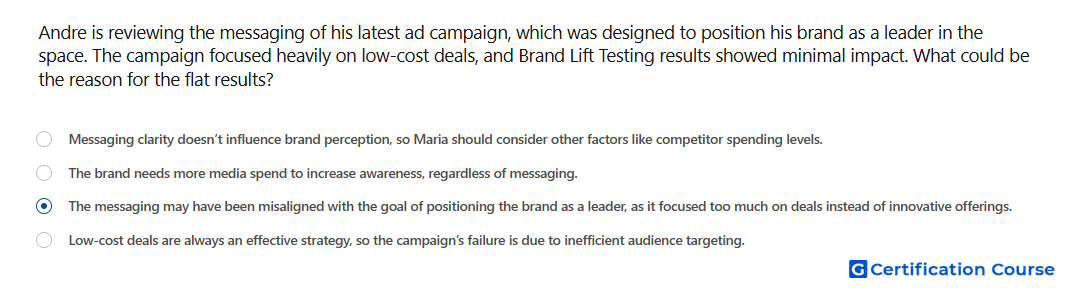
Question: Andre is reviewing the messaging of his latest ad campaign, which was designed to position his brand as a leader in the space. The campaign focused heavily on low-cost deals, and Brand Lift Testing results showed minimal impact. What could be the reason for the flat results?
- The messaging may have been misaligned with the goal of positioning the brand as a leader, as it focused too much on deals instead of innovative offerings.
- Messaging clarity doesn’t influence brand perception, so Maria should consider other factors like competitor spending levels.
- Low-cost deals are always an effective strategy, so the campaign’s failure is due to inefficient audience targeting.
- The brand needs more media spend to increase awareness, regardless of messaging.
Explanation
LinkedIn Brand Lift Testing measures whether ad exposure changes perceptions such as awareness, favorability, consideration, or intent. When the measured goal is leadership perception, the creative message must support that specific brand attribute. A deal-focused message can drive short-term interest but may not strengthen premium, innovative, or category-leader associations. Flat lift results can occur when the campaign message and the perception metric are not aligned.
Why the other options are incorrect
Messaging clarity is incorrect because message relevance can directly influence brand perception outcomes.
Low-cost deals is incorrect because promotional messaging does not automatically improve leadership perception.
More media spend is incorrect because additional delivery cannot fix a message that does not support the intended brand attribute.
Source for verification
https://www.linkedin.com/help/lms/answer/a590090
https://www.linkedin.com/help/lms/answer/a462020
The answer(s) to the question is highlighted in the BOLD text above. You can also find more questions and answers related to the exams on the "LinkedIn Marketing Measurement Certification" page.