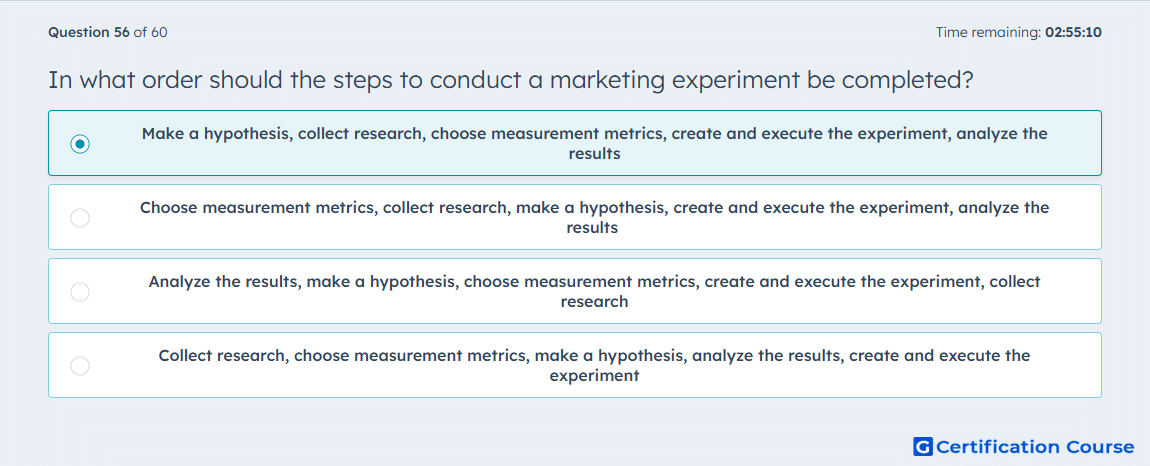
Question: In what order should the steps to conduct a marketing experiment be completed?
- Make a hypothesis, collect research, choose measurement metrics, create and execute the experiment, analyze the results
- Choose measurement metrics, collect research, make a hypothesis, create and execute the experiment, analyze the results
- Analyze the results, make a hypothesis, choose measurement metrics, create and execute the experiment, collect research
- Collect research, choose measurement metrics, make a hypothesis, analyze the results, create and execute the experiment
Explanation
The First interaction model gives 100% of the credit to the earliest recorded touchpoint in the conversion path. HubSpot recommends this model when the goal is to understand how people first discover the brand. That makes it the right choice for identifying which marketing effort is bringing new people in at the top of the funnel. It is designed to highlight initial discovery, not the later interactions that help close or accelerate conversion. HubSpot Knowledge Base+1
Why the other options are incorrect
Linear This spreads credit evenly across all interactions, so it does not isolate the original source that introduced the brand. HubSpot Knowledge Base
Last interaction This gives all credit to the final touchpoint before conversion, so it shows closing influence rather than first discovery. HubSpot Knowledge Base
Simple decay This gives more credit to recent interactions, which makes it better for later influence than for identifying the first marketing effort. HubSpot Knowledge Base
Source for verification
https://knowledge.hubspot.com/reports/understand-attribution-reporting
https://knowledge.hubspot.com/reports/create-attribution-reports
The answer(s) to the question is highlighted in the BOLD text above. You can also find more questions and answers related to the exams on the "HubSpot Digital Advertising" page.