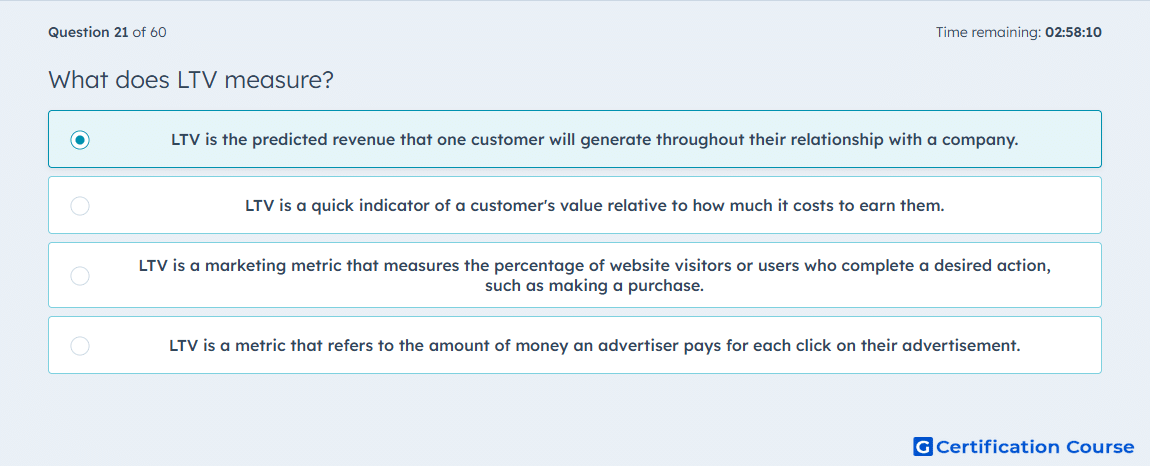
Question: What does LTV measure?
- LTV is the predicted revenue that one customer will generate throughout their relationship with a company.
- LTV is a quick indicator of a customer's value relative to how much it costs to earn them.
- LTV is a marketing metric that measures the percentage of website visitors or users who complete a desired action, such as making a purchase.
- LTV is a metric that refers to the amount of money an advertiser pays for each click on their advertisement.
Explanation
LTV (Lifetime Value) measures the total predicted revenue a single customer will generate over the entirety of their relationship with a company. It accounts for repeat purchases, upsells, and retention over time. In HubSpot, LTV helps prioritize high-value customers and informs marketing, sales, and service strategies. It enables forecasting revenue and assessing the long-term impact of customer acquisition efforts. LTV is a forward-looking metric, focusing on potential future revenue rather than immediate transactions.
Why the other options are incorrect
Option B describes a cost-to-acquire comparison, not LTV itself.
Option C defines a conversion rate metric, unrelated to revenue prediction.
Option D describes cost-per-click, which is an advertising metric, not customer value.
Source for verification
HubSpot LTV Reporting
The answer(s) to the question is highlighted in the BOLD text above. You can also find more questions and answers related to the exams on the "HubSpot Reporting" page.