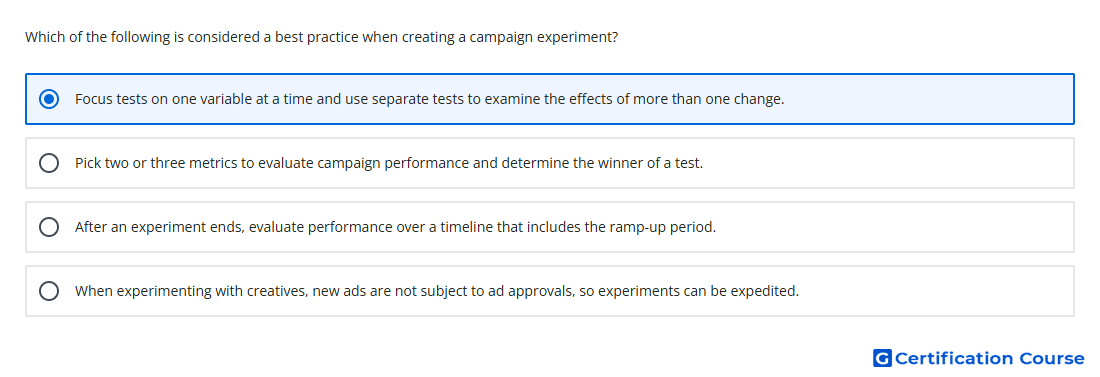
Question: Which of the following is considered a best practice when creating a campaign experiment?
- Focus tests on one variable at a time and use separate tests to examine the effects of more than one change.
- After an experiment ends, evaluate performance over a timeline that includes the ramp-up period.
- When experimenting with creatives, new ads are not subject to ad approvals, so experiments can be expedited.
- Pick two or three metrics to evaluate campaign performance and determine the winner of a test.
Explanation
A clean test in Google Ads experiments isolates the impact of one change. Testing multiple variables at once makes it difficult to identify which change caused the performance difference. Separate experiments allow each variable to be evaluated against a clear control. This improves decision quality because results can be tied to a specific campaign change.
Why the other options are incorrect
New ads are not subject to ad approvals is incorrect because ads in experiments must still comply with Google Ads policies.
Ramp-up period should be excluded from performance evaluation because the experiment needs time to stabilize.
Two or three metrics is not the best practice because the test should be tied to a clear hypothesis and primary success metric.
Source for verification
https://support.google.com/google-ads/answer/7281575
https://support.google.com/google-ads/answer/6167141
The answer(s) to the question is highlighted in the BOLD text above. You can also find more questions and answers related to the exams on the "Google Ads AI-Powered Performance Ads Assessment" page.