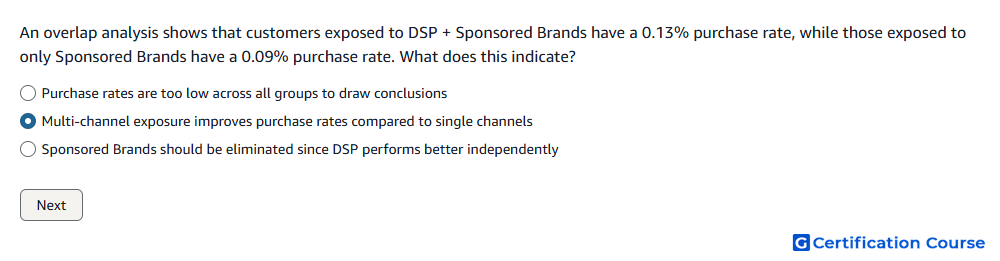
Question: An overlap analysis shows that customers exposed to DSP + Sponsored Brands have a 0.13% purchase rate, while those exposed to only Sponsored Brands have a 0.09% purchase rate. What does this indicate?
- Purchase rates are too low across all groups to draw conclusions
- Multi-channel exposure improves purchase rates compared to single channels
- Sponsored Brands should be eliminated since DSP performs better independently
Explanation
An overlap analysis compares performance for audiences reached through different media combinations. The higher purchase rate for customers exposed to both channels indicates that combined exposure is associated with stronger conversion behavior. In Amazon Marketing Cloud, this type of analysis helps evaluate cross-channel impact using aggregated event-level signals. The result supports maintaining coordinated media exposure rather than judging each channel in isolation.
Why the other options are incorrect
Purchase rates are too low is incorrect because the comparison shows a measurable difference between exposure groups.
Sponsored Brands is incorrect because the data shows stronger results when it works with DSP, not that it should be removed.
Source for verification
https://advertising.amazon.com/solutions/products/amazon-marketing-cloud
https://advertising.amazon.com/library/guides/amazon-marketing-cloud-guide
The answer(s) to the question is highlighted in the BOLD text above. You can also find more questions and answers related to the exams on the "Amazon Marketing Cloud Certification" page.