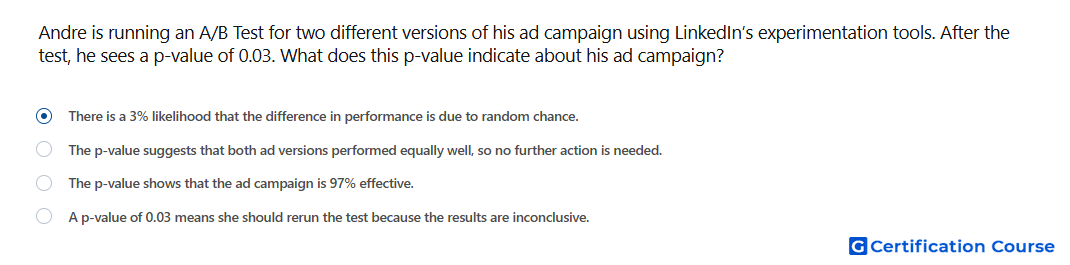
Question: Andre is running an A/B Test for two different versions of his ad campaign using LinkedIn’s experimentation tools. After the test, he sees a p-value of 0.03. What does this p-value indicate about his ad campaign?
- There is a 3% likelihood that the difference in performance is due to random chance.
- The p-value suggests that both ad versions performed equally well, so no further action is needed.
- The p-value shows that the ad campaign is 97% effective.
- A p-value of 0.03 means she should rerun the test because the results are inconclusive.
Explanation
LinkedIn A/B Testing uses statistical measurement to determine whether one campaign variation performed meaningfully better than another. A p-value shows the probability that the observed performance difference happened by random chance. A value of 0.03 means the result has a low chance of being random, which supports confidence in the observed difference. This helps advertisers make optimization decisions based on test evidence rather than surface-level performance variation.
Why the other options are incorrect
Equal performance is incorrect because a low p-value indicates a meaningful difference is more likely.
97% effective is incorrect because p-value measures statistical likelihood, not campaign effectiveness.
Rerun inconclusive is incorrect because 0.03 generally indicates the result is statistically meaningful.
Source for verification
https://www.linkedin.com/help/lms/answer/a529753
https://www.linkedin.com/help/lms/answer/a525922
The answer(s) to the question is highlighted in the BOLD text above. You can also find more questions and answers related to the exams on the "LinkedIn Marketing Measurement Certification" page.