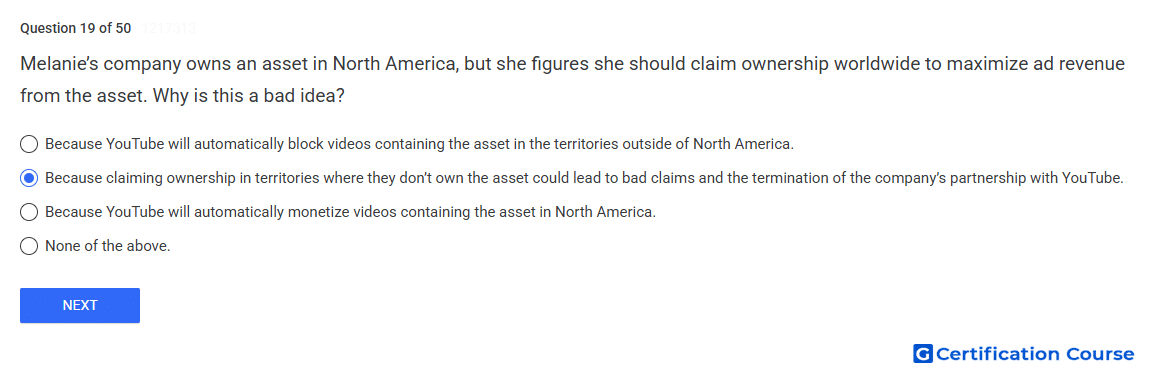
Question: Melanie’s company owns an asset in North America, but she figures she should claim ownership worldwide to maximize ad revenue from the asset. Why is this a bad idea?
- Because YouTube will automatically block videos containing the asset in the territories outside of North America.
- Because claiming ownership in territories where they don’t own the asset could lead to bad claims and the termination of the company’s partnership with YouTube.
- Because YouTube will automatically monetize videos containing the asset in North America.
- None of the above.
Explanation
A rightsholder should only assert ownership in territories where it actually controls the asset rights. Claiming worldwide rights for an asset owned only in North America can create invalid Content ID claims outside the controlled territories. YouTube treats abusive, fraudulent, or repeated erroneous claims as serious violations of Content Manager policies. These violations can lead to loss of Content ID access or termination of the YouTube partnership.
Why the other options are incorrect
Automatically block videos is incorrect because blocking depends on the applied policy and valid territorial ownership.
Automatically monetize videos is incorrect because monetization depends on the asset’s ownership and policy settings.
None of the above is incorrect because over-claiming outside owned territories can create serious policy violations.
Source for verification
https://support.google.com/youtube/answer/4352063?hl=en
https://support.google.com/youtube/answer/2797370?hl=en
The answer(s) to the question is highlighted in the BOLD text above. You can also find more questions and answers related to the exams on the "YouTube Music Rights Management" page.