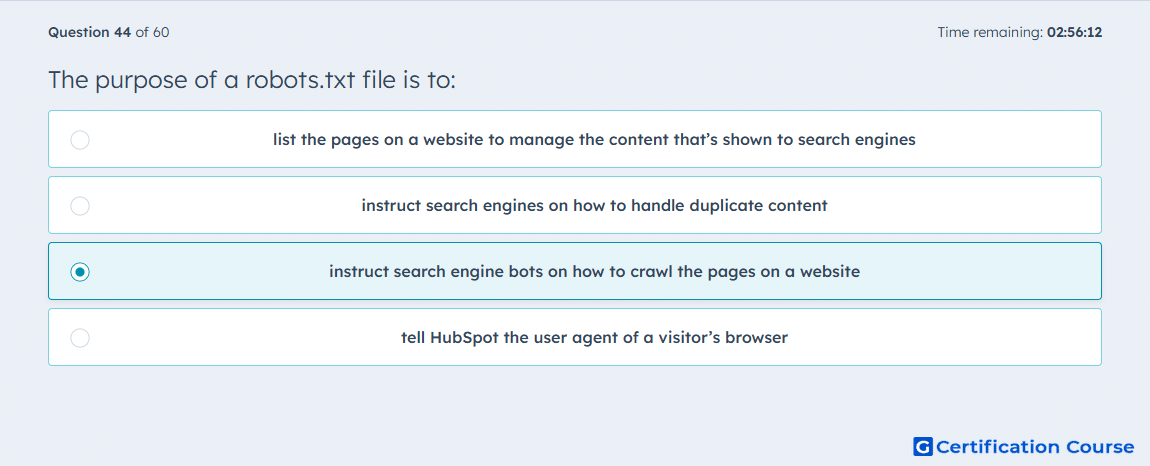
Question: The purpose of a robots.txt file is to:
- list the pages on a website to manage the content that’s shown to search engines
- instruct search engines on how to handle duplicate content
- instruct search engine bots on how to crawl the pages on a website
- tell HubSpot the user agent of a visitor’s browser
Explanation
A robots.txt file tells search engine crawlers which parts of a website they are allowed or not allowed to crawl. HubSpot’s documentation explains that search engines use this file to understand how to index website content, and the Disallow directive is used to prevent crawling of specific URL paths. HubSpot also treats a page blocked by robots.txt as a crawling and indexing issue in its SEO tools. That makes its purpose crawl control, not duplicate-content management, site mapping, or browser detection. HubSpot Knowledge Base+1
Why the other options are incorrect
A) This describes a sitemap, which lists URLs for search engines rather than giving crawl instructions.
B) Duplicate-content handling is done with tools such as a canonical URL or noindex, not with the main purpose of robots.txt.
D) A robots.txt file gives instructions to crawlers and has nothing to do with reporting a visitor’s browser user agent to HubSpot.
Source for verification
HubSpot Knowledge Base: Prevent content from appearing in search results. HubSpot Knowledge Base
HubSpot Knowledge Base: Understand SEO crawling errors. HubSpot Knowledge Base
The answer(s) to the question is highlighted in the BOLD text above. You can also find more questions and answers related to the exams on the "HubSpot Content Hub For Marketers" page.