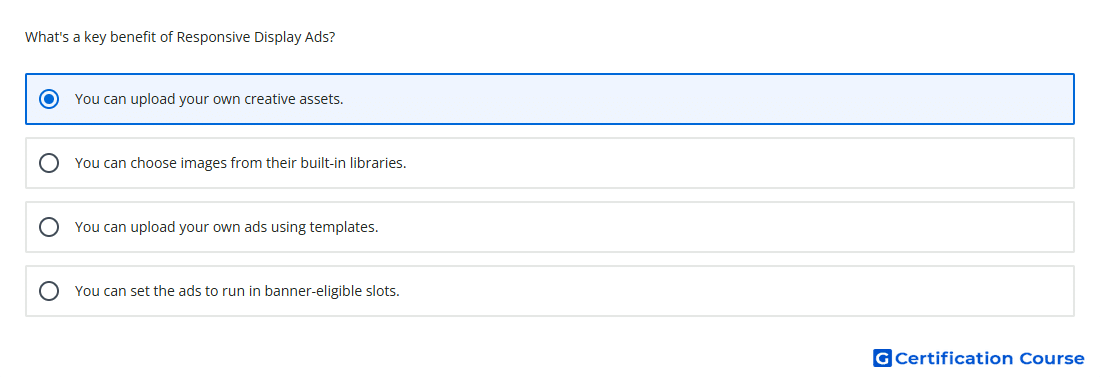
Question: What's a key benefit of Responsive Display Ads?
- You can upload your own creative assets.
- You can upload your own ads using templates.
- You can set the ads to run in banner-eligible slots.
- You can choose images from their built-in libraries.
Explanation
Responsive display ads operate by having advertisers supply individual text, image, and video components directly into the platform interface. Instead of designing complete, static banners, marketers provide these raw elements to fuel the underlying machine learning models. The system automatically tests and assembles these pieces into thousands of unique combinations at the exact moment of the auction. This dynamic generation allows the resulting promotions to seamlessly adapt their size, appearance, and format to fit virtually any available space across the Google Display Network. Ultimately, this mechanism maximizes reach while eliminating the need to manually build custom graphics for every potential publisher layout.
Why the other options are incorrect
Uploading ads using templates restricts the dynamic nature of the system, which is engineered to assemble elements fluidly rather than forcing them into rigid, pre-defined layouts.
Setting ads for banner-eligible slots ignores the format's ability to seamlessly adapt into native and text-based inventory rather than being confined exclusively to traditional banner spaces.
Choosing images from built-in libraries represents a supplementary stock feature rather than the primary mechanism of supplying proprietary brand elements to the automated algorithms.
Source for verification
https://support.google.com/google-ads/answer/6363750
The answer(s) to the question is highlighted in the BOLD text above. You can also find more questions and answers related to the exams on the "Google Ads Display Certification" page.