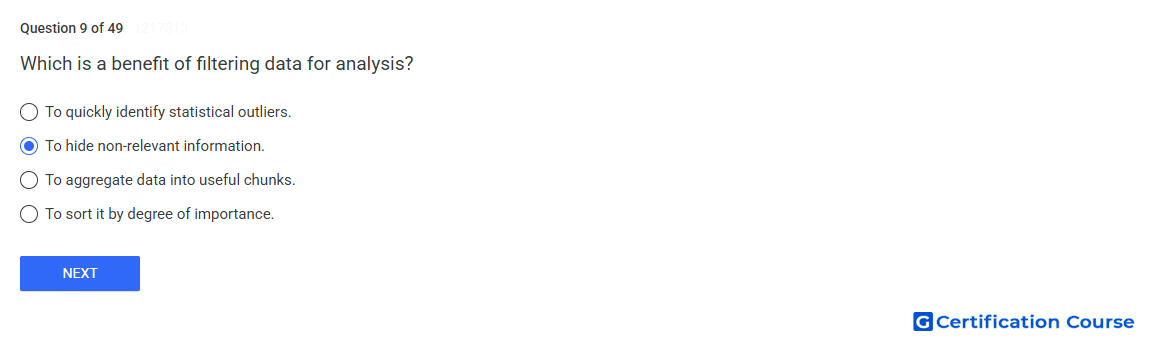
Question: Which is a benefit of filtering data for analysis?
- To quickly identify statistical outliers.
- To hide non-relevant information.
- To aggregate data into useful chunks.
- To sort it by degree of importance.
Explanation
Filtering in YouTube Analytics narrows a report so only relevant data remains visible. This helps isolate the specific audience, content, traffic source, or performance area being reviewed. Removing unrelated data makes patterns easier to interpret without changing the underlying metrics. Filters support focused analysis when working with detailed reports in Advanced Mode.
Why the other options are incorrect
Statistical outliers may be identified through analysis, but filtering is primarily used to limit visible data.
Aggregate data refers to combining data, not hiding unrelated information.
Sort by importance changes order, while filtering controls which data is shown.
Source for verification
https://support.google.com/youtube/answer/9002587
The answer(s) to the question is highlighted in the BOLD text above. You can also find more questions and answers related to the exams on the "YouTube Content Ownership" page.