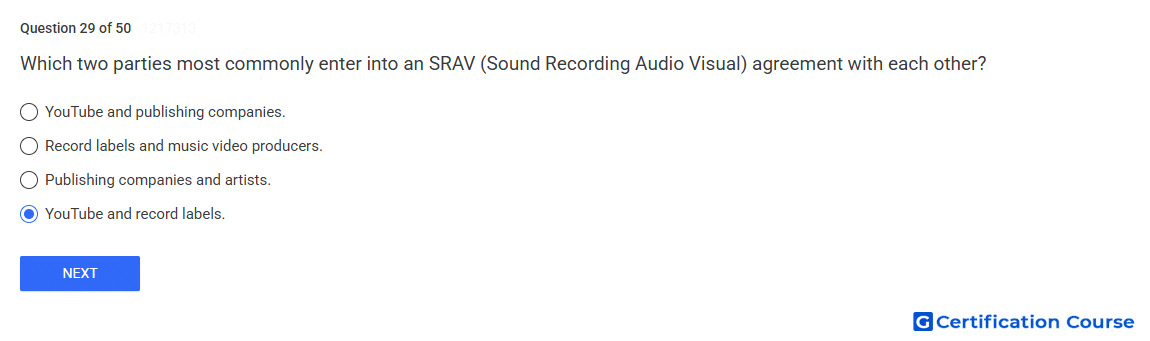
Question: Which two parties most commonly enter into an SRAV (Sound Recording Audio Visual) agreement with each other?
- YouTube and publishing companies.
- Record labels and music video producers.
- Publishing companies and artists.
- YouTube and record labels.
Explanation
An SRAV agreement concerns sound recording audiovisual rights for music use on YouTube. In YouTube’s music rights framework, Sound Recording assets are normally controlled and delivered by record labels. YouTube contracts directly with record labels to authorize use, monetization, and management of those sound recording rights. Publishing companies are associated with Composition Share assets, not the primary SRAV relationship.
Why the other options are incorrect
YouTube and publishing companies is incorrect because publishers primarily manage composition rights, not sound recording audiovisual rights.
Record labels and music video producers is incorrect because SRAV refers to YouTube’s rights relationship, not production services.
Publishing companies and artists is incorrect because this describes publishing or artist rights relationships, not YouTube sound recording audiovisual licensing.
Source for verification
https://support.google.com/youtube/answer/2822002
https://support.google.com/youtube/answer/9234170
The answer(s) to the question is highlighted in the BOLD text above. You can also find more questions and answers related to the exams on the "YouTube Music Assessment" page.