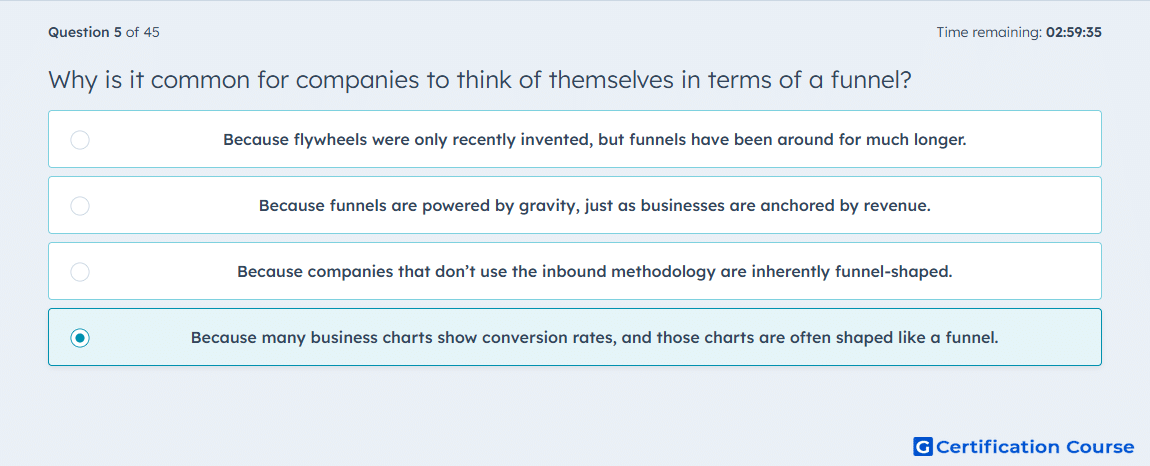
Question: Why is it common for companies to think of themselves in terms of a funnel?
- Because flywheels were only recently invented, but funnels have been around for much longer.
- Because funnels are powered by gravity, just as businesses are anchored by revenue.
- Because companies that don’t use the inbound methodology are inherently funnel-shaped.
- Because many business charts show conversion rates, and those charts are often shaped like a funnel.
Explanation
Businesses often visualize performance using conversion rate charts, which naturally taper from a larger number of leads at the top to fewer conversions at the bottom. This visual representation resembles a funnel, making it an intuitive model for tracking prospects through stages. It emphasizes linear progression from awareness to purchase, highlighting drop-off points. The funnel metaphor aligns with reporting metrics and traditional sales tracking methods.
Why the other options are incorrect
A incorrectly frames funnels as a historical invention rather than a visualization tool.
B draws a literal analogy to gravity, which has no conceptual relevance.
C wrongly associates non-inbound companies with funnel shape instead of chart visualization.
Source for verification
HubSpot Knowledge Base – Why Businesses Use Funnels
The answer(s) to the question is highlighted in the BOLD text above. You can also find more questions and answers related to the exams on the "HubSpot Inbound Certification" page.