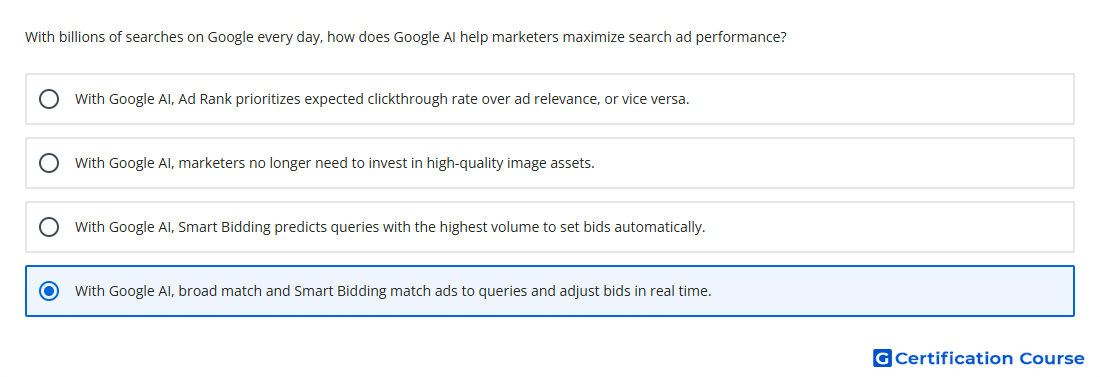
Question: With billions of searches on Google every day, how does Google AI help marketers maximize search ad performance?
- With Google AI, Ad Rank prioritizes expected clickthrough rate over ad relevance, or vice versa.
- With Google AI, broad match and Smart Bidding match ads to queries and adjust bids in real time.
- With Google AI, Smart Bidding predicts queries with the highest volume to set bids automatically.
- With Google AI, marketers no longer need to invest in high-quality image assets.
Explanation
The combination of broad match and Smart Bidding allows the system to analyze vast amounts of real-time signals during the auction process. Machine learning algorithms assess the unique context of each search query rather than relying strictly on exact keyword phrasing. This predictive capability identifies high-intent traffic that static targeting methods often miss. Consequently, the automated bidding mechanism optimizes the financial offer for every individual auction to maximize conversions within the specified budget parameters. This integrated approach ensures the most relevant marketing asset reaches the exact right user at the optimal moment.
Why the other options are incorrect
Prioritizing expected clickthrough rate over ad relevance is incorrect because the auction formula evaluates both metrics simultaneously without artificially ranking one performance component above the other.
Predicting queries with the highest volume is incorrect because automated bidding optimizes for conversion likelihood rather than simply targeting the maximum amount of search traffic.
No longer needing high-quality image assets is incorrect because the machine learning models rely heavily on diverse, high-quality creative inputs to generate effective responsive ad formats.
Source for verification
https://support.google.com/google-ads/answer/7065882
The answer(s) to the question is highlighted in the BOLD text above. You can also find more questions and answers related to the exams on the "Google Ads Search Certification" page.