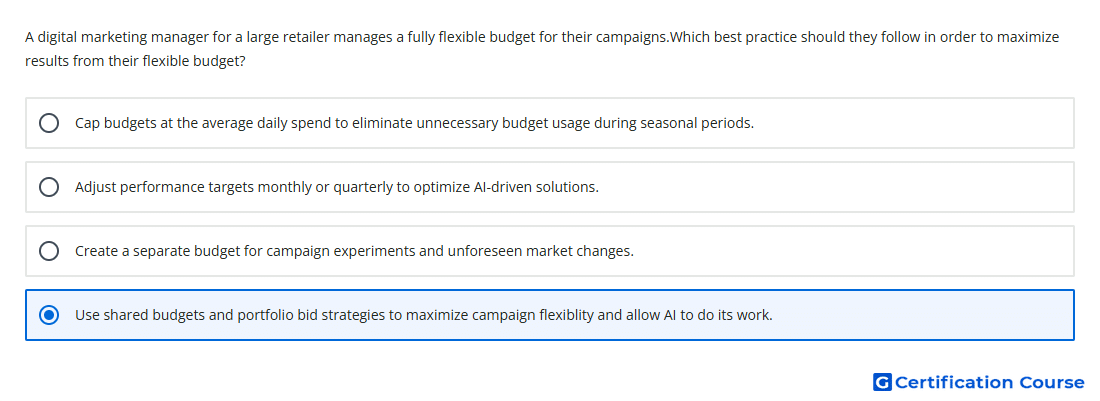
Question: A digital marketing manager for a large retailer manages a fully flexible budget for their campaigns.Which best practice should they follow in order to maximize results from their flexible budget?
- Cap budgets at the average daily spend to eliminate unnecessary budget usage during seasonal periods.
- Use shared budgets and portfolio bid strategies to maximize campaign flexiblity and allow AI to do its work.
- Create a separate budget for campaign experiments and unforeseen market changes.
- Adjust performance targets monthly or quarterly to optimize AI-driven solutions.
Explanation
Shared budgets allow multiple campaigns to draw from a common budget instead of being restricted by separate campaign-level caps. Portfolio bid strategies group campaigns with similar goals so Google AI can optimize bids across them more efficiently. This setup gives the system more flexibility to allocate spend toward stronger opportunities. It is especially useful when budgets are flexible and performance goals are shared across campaigns.
Why the other options are incorrect
Cap budgets limits flexibility and can prevent spend from moving toward high-demand opportunities.
Separate budget can reduce budget fluidity when campaigns need to respond to changing market conditions.
Monthly or quarterly target adjustments are too infrequent to be the primary best practice for maximizing flexible budget performance.
Source for verification
https://support.google.com/google-ads/answer/11239164
https://support.google.com/google-ads/answer/10487241
The answer(s) to the question is highlighted in the BOLD text above. You can also find more questions and answers related to the exams on the "Google Ads AI-Powered Performance Ads Assessment" page.