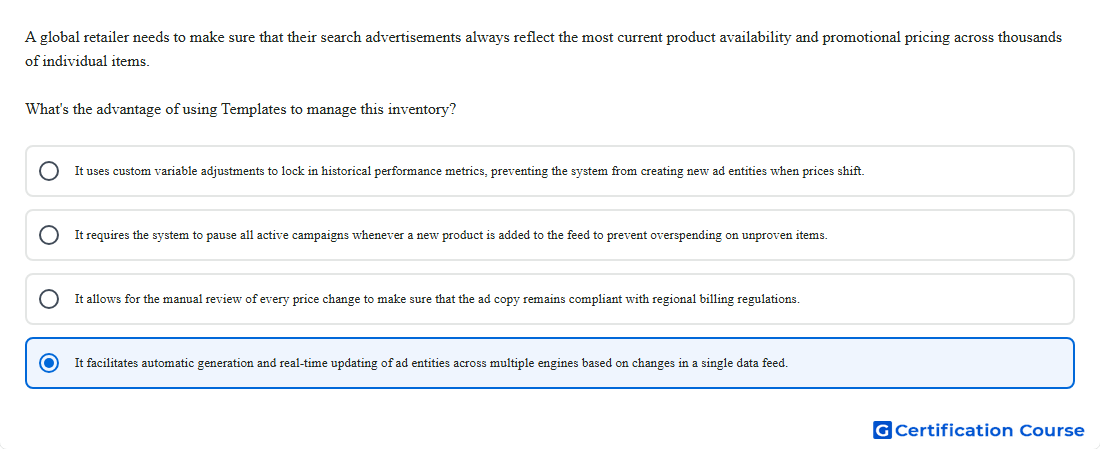
Question: A global retailer needs to make sure that their search advertisements always reflect the most current product availability and promotional pricing across thousands of individual items. What's the advantage of using Templates to manage this inventory?
- It uses custom variable adjustments to lock in historical performance metrics, preventing the system from creating new ad entities when prices shift.
- It requires the system to pause all active campaigns whenever a new product is added to the feed to prevent overspending on unproven items.
- It allows for the manual review of every price change to make sure that the ad copy remains compliant with regional billing regulations.
- It facilitates automatic generation and real-time updating of ad entities across multiple engines based on changes in a single data feed.
Explanation
Templates use a connected feed to create and update search entities from current inventory data. In Search Ads 360, templates can generate campaigns, ad groups, ads, keywords, and sitelinks from feed columns. This supports large product catalogs because availability and promotional details can be reflected when the feed changes. The same template logic can manage search structures across supported engine accounts.
Why the other options are incorrect
Pause all active campaigns is incorrect because templates do not require pausing every campaign when feed rows change.
Custom variable adjustments is incorrect because templates use current feed data to create or update entities, not to block new entities from price changes.
Manual review is incorrect because templates are designed to reduce manual updates across large inventory sets.
Source for verification
https://support.google.com/sa360/answer/12966436
https://support.google.com/sa360/answer/13074411
The answer(s) to the question is highlighted in the BOLD text above. You can also find more questions and answers related to the exams on the "Search Ads 360" page.