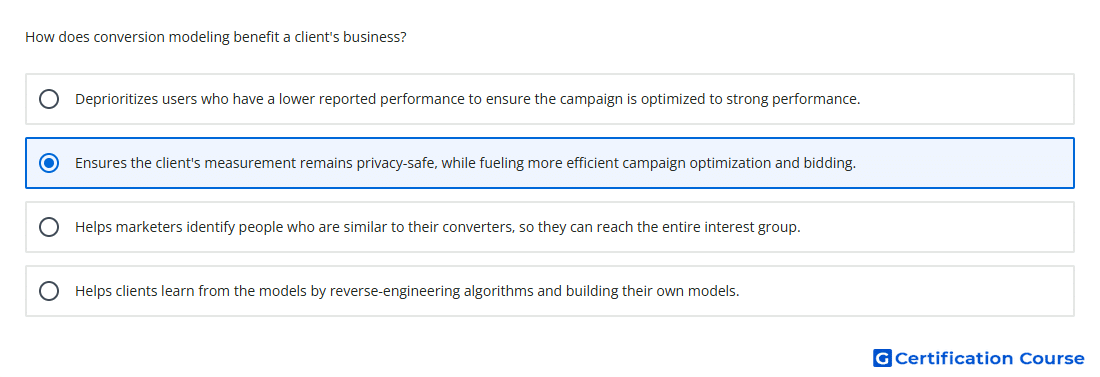
Question: How does conversion modeling benefit a client's business?
- Helps clients learn from the models by reverse-engineering algorithms and building their own models.
- Helps marketers identify people who are similar to their converters, so they can reach the entire interest group.
- Deprioritizes users who have a lower reported performance to ensure the campaign is optimized to strong performance.
- Ensures the client's measurement remains privacy-safe, while fueling more efficient campaign optimization and bidding.
Explanation
Conversion modeling helps fill measurement gaps when some conversions cannot be directly observed. It uses observed conversions to estimate unobserved conversions without identifying individual users. Modeled conversions can provide a more complete view of campaign performance. This supports Smart Bidding by giving automated bidding more complete conversion signals for optimization.
Why the other options are incorrect
Lower reported performance is incorrect because conversion modeling estimates missing conversions rather than suppressing users.
Reverse-engineering algorithms is incorrect because Google does not provide model logic for advertisers to replicate.
Similar converters is incorrect because finding new users similar to converters is an audience activation use case, not conversion modeling.
Source for verification
https://support.google.com/google-ads/answer/12443859
https://support.google.com/google-ads/answer/12445060
The answer(s) to the question is highlighted in the BOLD text above. You can also find more questions and answers related to the exams on the "Privacy for Agencies and Partners Certification" page.