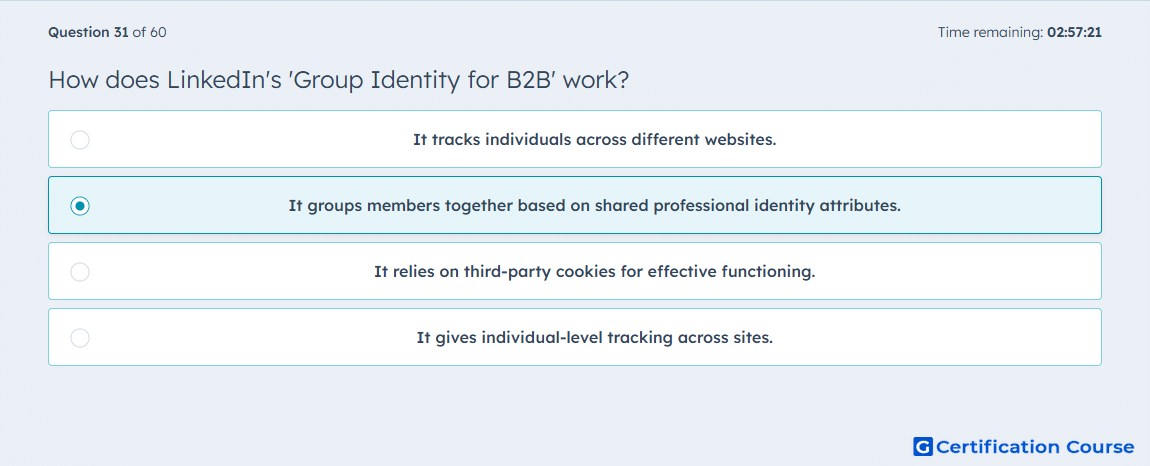
Question: How does LinkedIn's 'Group Identity for B2B' work?
- It tracks individuals across different websites.
- It groups members together based on shared professional identity attributes.
- It relies on third-party cookies for effective functioning.
- It gives individual-level tracking across sites.
Explanation
This approach uses shared professional attributes to create audience groups instead of relying on individual cross-site tracking. In Amazon DSP, privacy-aware audience planning similarly depends on signals that support relevance without unnecessary individual-level tracking. Group-based identity can help advertisers reach B2B audiences while respecting changing privacy expectations. It aligns with signal-based marketing, where durable signals are used to improve relevance as third-party cookies become less dependable.
Why the other options are incorrect
Individual cross-site tracking is incorrect because the approach is based on grouped identity attributes, not personal tracking across websites.
Third-party cookies is incorrect because privacy-aware identity approaches are designed to reduce reliance on third-party cookies.
Individual-level tracking is incorrect because the method focuses on grouped audience identity rather than user-level surveillance.
Source for verification
https://advertising.amazon.com/library/guides/signal-based-marketing
https://advertising.amazon.com/library/guides/addressable-advertising
The answer(s) to the question is highlighted in the BOLD text above. You can also find more questions and answers related to the exams on the "Social Media Marketing Certification II" page.