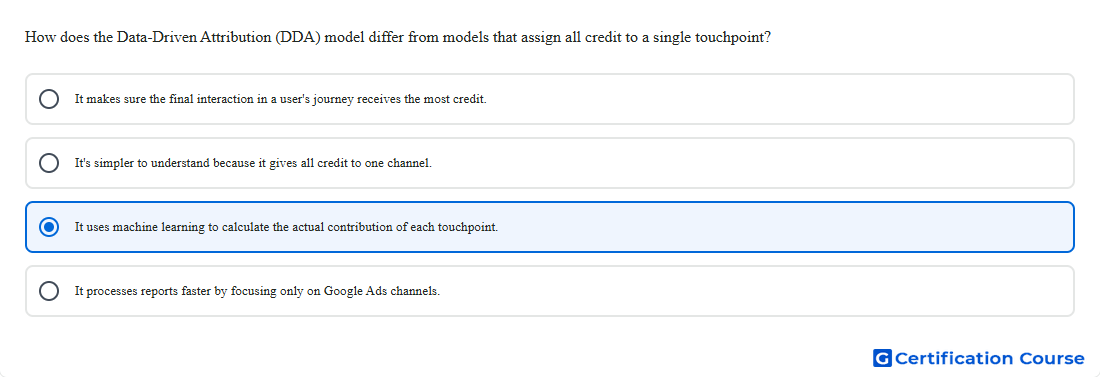
Question: How does the Data-Driven Attribution (DDA) model differ from models that assign all credit to a single touchpoint?
- It's simpler to understand because it gives all credit to one channel.
- It processes reports faster by focusing only on Google Ads channels.
- It uses machine learning to calculate the actual contribution of each touchpoint.
- It makes sure the final interaction in a user's journey receives the most credit.
Explanation
Data-driven attribution distributes credit for a key event based on data from each touchpoint in the user journey. It differs from single-touchpoint models because it does not assign all credit to only the first or last interaction. The model uses machine learning to evaluate converting and non-converting paths. This helps estimate the actual contribution of each interaction to the key event outcome.
Why the other options are incorrect
Final interaction credit is incorrect because that describes a last-click approach, not data-driven attribution.
Single-channel simplicity is incorrect because data-driven attribution assigns fractional credit across contributing touchpoints.
Google Ads-only processing is incorrect because the model is about credit assignment methodology, not faster reporting limited to Google Ads channels.
Source for verification
https://support.google.com/analytics/answer/10596866
The answer(s) to the question is highlighted in the BOLD text above. You can also find more questions and answers related to the exams on the "Google Analytics Certification" page.