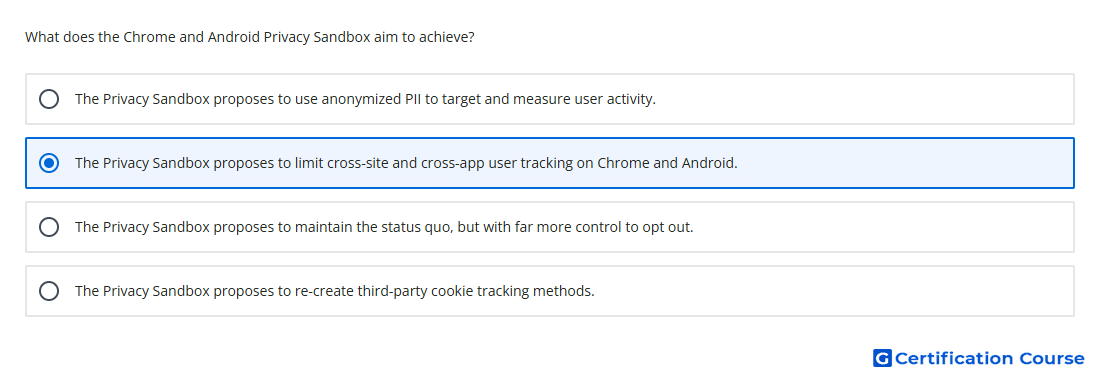
Question: What does the Chrome and Android Privacy Sandbox aim to achieve?
- The Privacy Sandbox proposes to maintain the status quo, but with far more control to opt out.
- The Privacy Sandbox proposes to use anonymized PII to target and measure user activity.
- The Privacy Sandbox proposes to re-create third-party cookie tracking methods.
- The Privacy Sandbox proposes to limit cross-site and cross-app user tracking on Chrome and Android.
Explanation
Privacy Sandbox is designed to improve user privacy while supporting key digital advertising use cases. Its proposals reduce reliance on cross-site and cross-app identifiers. On Chrome and Android, the goal is to limit tracking while still enabling relevance, remarketing, and measurement through privacy-preserving APIs. This supports advertising utility without recreating unrestricted third-party cookie behavior.
Why the other options are incorrect
Third-party cookie tracking is incorrect because Privacy Sandbox is intended to replace, not recreate, those tracking methods.
Status quo is incorrect because Privacy Sandbox changes how advertising use cases work rather than preserving existing tracking systems.
Anonymized PII is incorrect because Privacy Sandbox does not target or measure activity using anonymized personally identifiable information.
Source for verification
https://privacysandbox.google.com/
https://privacysandbox.google.com/android/overview
The answer(s) to the question is highlighted in the BOLD text above. You can also find more questions and answers related to the exams on the "Privacy for Agencies and Partners Certification" page.