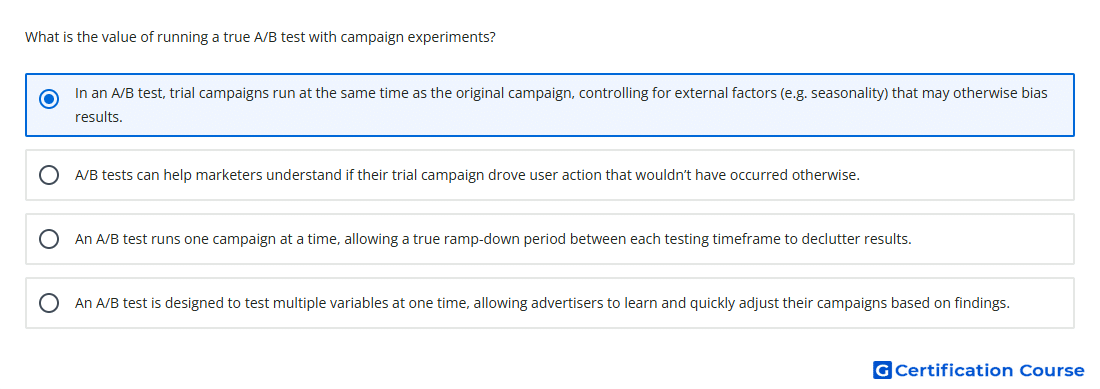
Question: What is the value of running a true A/B test with campaign experiments?
- A/B tests can help marketers understand if their trial campaign drove user action that wouldn’t have occurred otherwise.
- In an A/B test, trial campaigns run at the same time as the original campaign, controlling for external factors (e.g. seasonality) that may otherwise bias results.
- An A/B test runs one campaign at a time, allowing a true ramp-down period between each testing timeframe to declutter results.
- An A/B test is designed to test multiple variables at one time, allowing advertisers to learn and quickly adjust their campaigns based on findings.
Explanation
Google Ads experiments compare a base campaign and trial version during the same time period. This helps reduce bias from external shifts such as seasonality, competitor activity, or demand changes. Running both versions concurrently makes the performance comparison more reliable. A clean A/B experiment should isolate one meaningful change so results can be tied to that variable.
Why the other options are incorrect
Multiple variables weakens test clarity because results cannot be linked to one specific change.
Sequential campaigns can introduce timing bias because market conditions may differ between test periods.
Incrementality is measured with lift-based methods, not the standard purpose of campaign experiments.
Source for verification
https://support.google.com/google-ads/answer/7281575
https://support.google.com/google-ads/answer/6261395
The answer(s) to the question is highlighted in the BOLD text above. You can also find more questions and answers related to the exams on the "Google Ads AI-Powered Performance Ads Assessment" page.