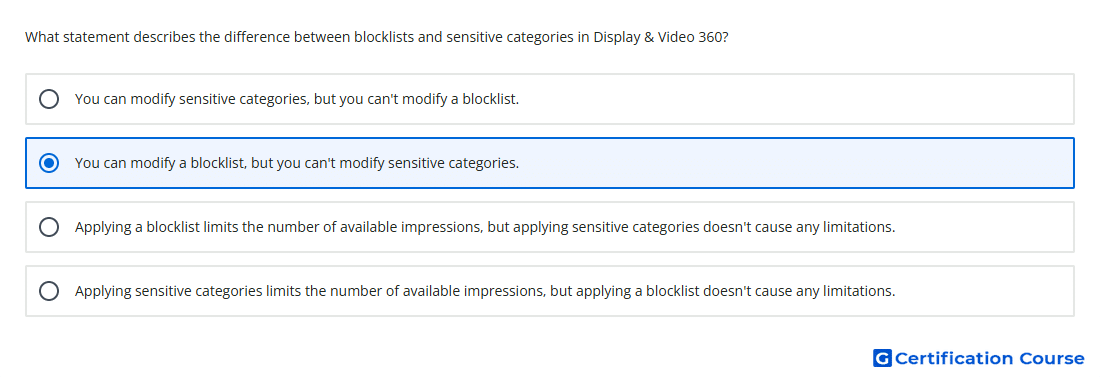
Question: What statement describes the difference between blocklists and sensitive categories in Display & Video 360?
- Applying a blocklist limits the number of available impressions, but applying sensitive categories doesn't cause any limitations.
- Applying sensitive categories limits the number of available impressions, but applying a blocklist doesn't cause any limitations.
- You can modify a blocklist, but you can't modify sensitive categories.
- You can modify sensitive categories, but you can't modify a blocklist.
Explanation
Blocklists in Display & Video 360 are advertiser-controlled lists of apps, URLs, or channels that can be added, removed, or edited. Sensitive categories are predefined content classifications created by Google to block inventory based on surrounding subject matter. Because sensitive category labels are system-defined, their category structure cannot be customized. This makes blocklists flexible for advertiser-specific exclusions, while sensitive categories provide fixed brand safety exclusions.
Why the other options are incorrect
Impression limits for blocklists only is incorrect because both exclusion methods can reduce available inventory.
Sensitive categories editable is incorrect because the category taxonomy is predefined by Display & Video 360.
Blocklists no impression limits is incorrect because blocking apps, URLs, or channels can reduce eligible impressions.
Source for verification
https://support.google.com/displayvideo/answer/3032915
https://support.google.com/displayvideo/answer/9179543
The answer(s) to the question is highlighted in the BOLD text above. You can also find more questions and answers related to the exams on the "Display & Video 360" page.