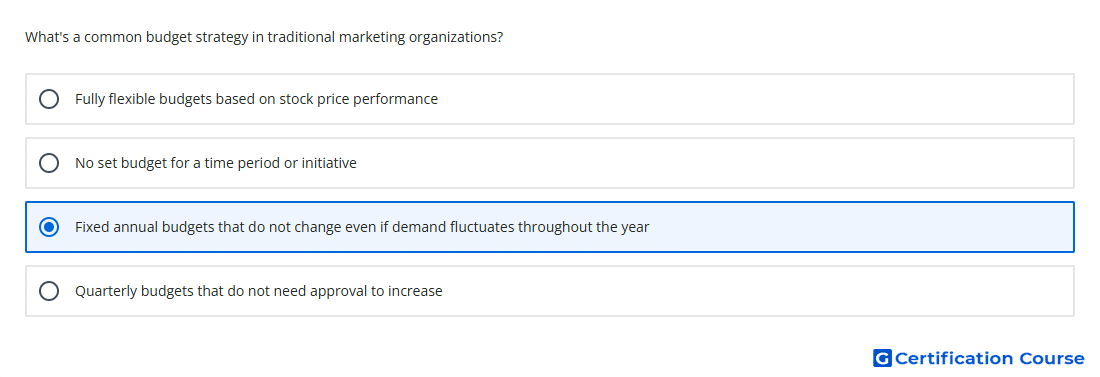
Question: What's a common budget strategy in traditional marketing organizations?
- Fully flexible budgets based on stock price performance
- No set budget for a time period or initiative
- Fixed annual budgets that do not change even if demand fluctuates throughout the year
- Quarterly budgets that do not need approval to increase
Explanation
Traditional planning often sets media investment before demand and performance signals are known. This can make it harder for Google AI to capture incremental opportunities when consumer demand changes. AI-powered strategies perform better when budgets can respond to conversion potential and market shifts. Rigid budget planning can restrict tools such as Smart Bidding from scaling toward higher-value opportunities.
Why the other options are incorrect
Quarterly budgets describe a more flexible approval model, not a common traditional constraint.
Fully flexible budgets are aligned with AI-powered budget agility, not traditional budgeting.
No set budget does not reflect structured annual planning or controlled investment governance.
Source for verification
https://support.google.com/google-ads/answer/13580022
https://support.google.com/google-ads/answer/2375420
The answer(s) to the question is highlighted in the BOLD text above. You can also find more questions and answers related to the exams on the "Google Ads AI-Powered Performance Ads Assessment" page.