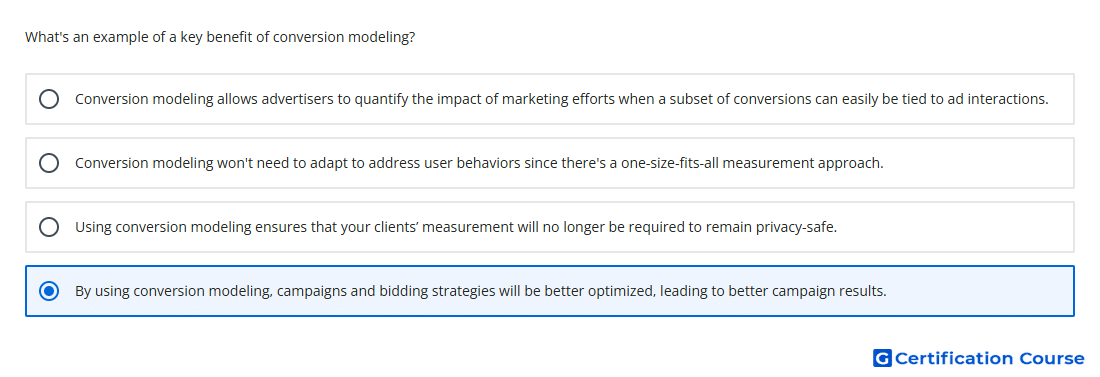
Question: What's an example of a key benefit of conversion modeling?
- By using conversion modeling, campaigns and bidding strategies will be better optimized, leading to better campaign results.
- Conversion modeling allows advertisers to quantify the impact of marketing efforts when a subset of conversions can easily be tied to ad interactions.
- Conversion modeling won't need to adapt to address user behaviors since there's a one-size-fits-all measurement approach.
- Using conversion modeling ensures that your clients’ measurement will no longer be required to remain privacy-safe.
Explanation
Conversion modeling helps campaigns optimize from a more complete view of performance when some conversions cannot be directly observed. It uses observed conversions to estimate unobserved conversions without identifying individual users. Modeled conversions improve reporting quality by filling gaps in the customer journey. More complete conversion data can strengthen bidding signals for Smart Bidding and support better campaign results.
Why the other options are incorrect
No privacy-safe requirement is incorrect because conversion modeling is designed to preserve privacy-safe measurement.
Easily tied conversions is incorrect because conversion modeling is most useful when some conversions cannot be directly tied to ad interactions.
One-size-fits-all measurement is incorrect because modeling adapts to available signals and measurement conditions.
Source for verification
https://support.google.com/google-ads/answer/12443859
https://support.google.com/google-ads/answer/10081327
The answer(s) to the question is highlighted in the BOLD text above. You can also find more questions and answers related to the exams on the "Privacy for Agencies and Partners Certification" page.