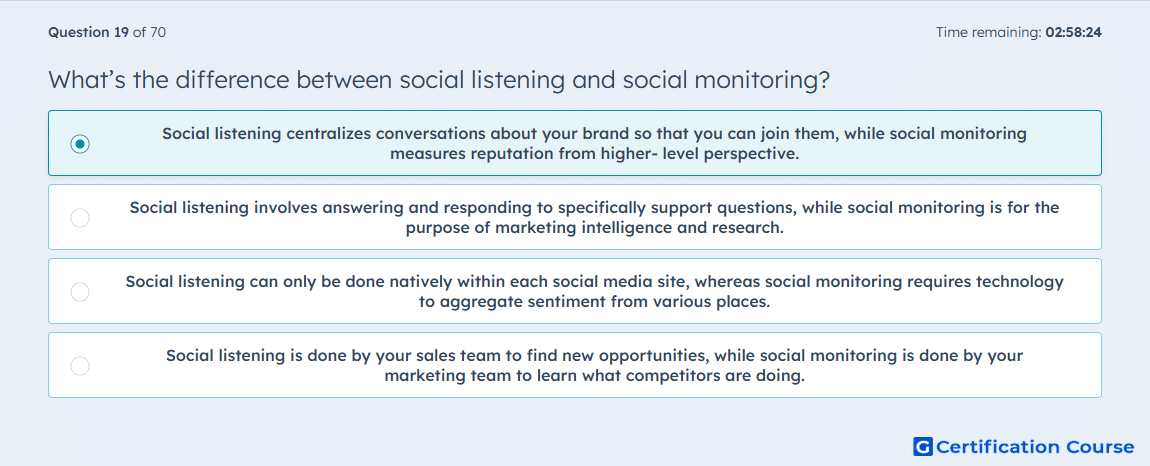
Question: What’s the difference between social listening and social monitoring?
- Social listening centralizes conversations about your brand so that you can join them, while social monitoring measures reputation from higher- level perspective.
- Social listening involves answering and responding to specifically support questions, while social monitoring is for the purpose of marketing intelligence and research.
- Social listening can only be done natively within each social media site, whereas social monitoring requires technology to aggregate sentiment from various places.
- Social listening is done by your sales team to find new opportunities, while social monitoring is done by your marketing team to learn what competitors are doing.
Explanation
Social listening focuses on collecting and understanding conversations across channels so a brand can identify relevant discussions and respond when appropriate. Social monitoring evaluates broader patterns, reputation, and sentiment over time. In Amazon Ads terminology, these insights can support brand health by showing how audiences perceive a brand, product, or service. The difference is based on action-level engagement versus higher-level reputation analysis.
Why the other options are incorrect
Support questions is incorrect because answering service questions is not the main distinction between listening and monitoring.
Native-only listening is incorrect because listening can use tools that aggregate conversations across multiple sources.
Sales team listening is incorrect because the difference is not defined by which internal team uses the activity.
Source for verification
https://advertising.amazon.com/library/guides/brand-health-tracking
https://advertising.amazon.com/library/guides/brand-engagement
The answer(s) to the question is highlighted in the BOLD text above. You can also find more questions and answers related to the exams on the "HubSpot Social Media Certification" page.