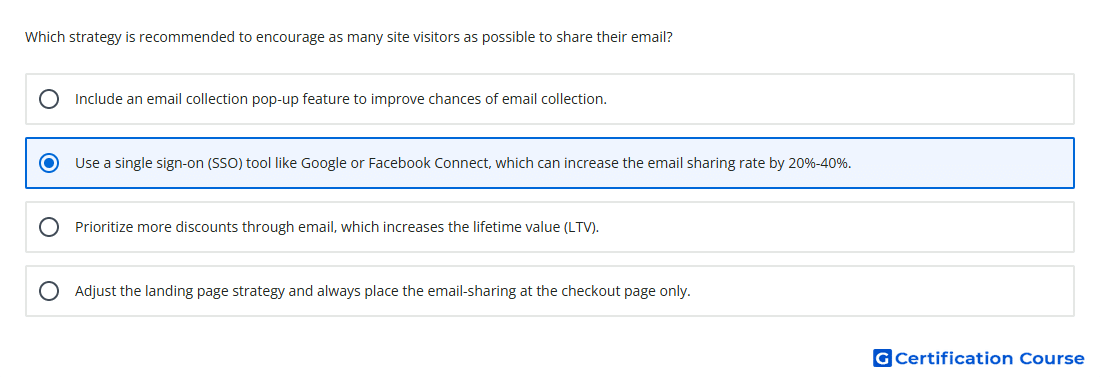
Question: Which strategy is recommended to encourage as many site visitors as possible to share their email?
- Include an email collection pop-up feature to improve chances of email collection.
- Use a single sign-on (SSO) tool like Google or Facebook Connect, which can increase the email sharing rate by 20%-40%.
- Adjust the landing page strategy and always place the email-sharing at the checkout page only.
- Prioritize more discounts through email, which increases the lifetime value (LTV).
or
- Use a Single Sign-On (SSO) tool like Google or Facebook Connect, which can increase the email sharing rate by 20–40%.
- Include an email collection pop-up feature to improve chances of email collection.
- Prioritise more discounts through email, which increases the lifetime value (LTV).
- Adjust the landing page strategy and always place the email sharing on the checkout page only.
Explanation
Reducing sign-up friction increases the likelihood that visitors complete email-sharing actions. Sign in with Google supports account creation and sign-in with a familiar identity flow. This helps build consented first-party data from direct customer interactions. A smoother authentication path supports a durable data foundation without relying on third-party identifiers.
Why the other options are incorrect
Checkout-only email sharing is incorrect because waiting until checkout misses earlier opportunities to collect consented information.
Discount-focused collection is incorrect because discounts alone do not create a durable privacy-safe data strategy.
Email collection pop-up is incorrect because a pop-up can add friction and does not provide the same streamlined authentication value.
Source for verification
https://developers.google.com/identity/gsi/web/guides/overview
https://business.google.com/us/privacy/strategy/
The answer(s) to the question is highlighted in the BOLD text above. You can also find more questions and answers related to the exams on the "Privacy for Agencies and Partners Certification" page.