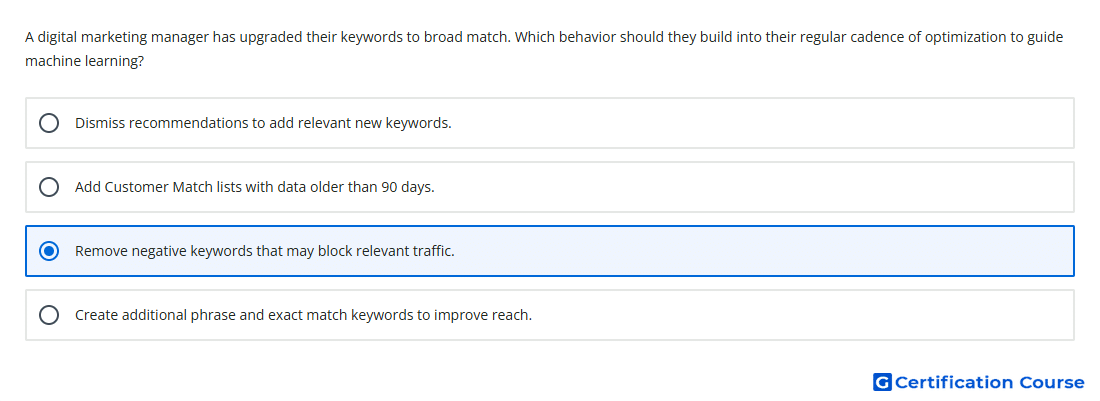
Question: A digital marketing manager has upgraded their keywords to broad match. Which behavior should they build into their regular cadence of optimization to guide machine learning?
- Dismiss recommendations to add relevant new keywords.
- Create additional phrase and exact match keywords to improve reach.
- Add Customer Match lists with data older than 90 days.
- Remove negative keywords that may block relevant traffic.
Explanation
Broad match relies on Google AI to match ads with relevant searches beyond exact keyword wording. Regularly reviewing negative keywords helps ensure they are not overly restrictive. If exclusions are too broad, they can prevent useful queries from entering the auction. This supports machine learning by allowing more relevant traffic and performance signals to be evaluated.
Why the other options are incorrect
Relevant new keyword recommendations should not be routinely dismissed when they align with campaign goals.
Phrase and exact match keywords are not needed to improve reach after moving to broad match.
Customer Match lists older than 90 days may be less useful because fresher first-party data provides stronger signals.
Source for verification
https://support.google.com/google-ads/answer/2407779
https://support.google.com/google-ads/answer/2453972
The answer(s) to the question is highlighted in the BOLD text above. You can also find more questions and answers related to the exams on the "Google Ads AI-Powered Performance Ads Assessment" page.