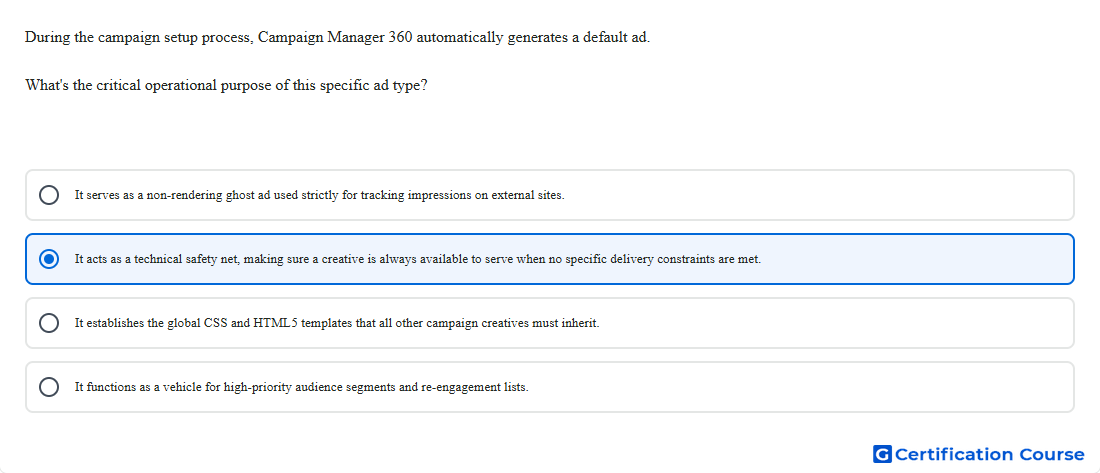
Question: During the campaign setup process, Campaign Manager 360 automatically generates a default ad. What's the critical operational purpose of this specific ad type?
- It functions as a vehicle for high-priority audience segments and re-engagement lists.
- It acts as a technical safety net, making sure a creative is always available to serve when no specific delivery constraints are met.
- It serves as a non-rendering ghost ad used strictly for tracking impressions on external sites.
- It establishes the global CSS and HTML5 templates that all other campaign creatives must inherit.
Explanation
A default ad is assigned so a placement can serve an eligible creative when no other assigned ad can serve. It protects delivery when targeting, status, scheduling, or other ad-serving conditions prevent regular ads from being selected. In Campaign Manager 360, this prevents blank or unintended delivery behavior for live tags. The operational role is fallback delivery, not tracking, templating, or audience prioritization.
Why the other options are incorrect
Non-rendering ghost ad describes tracking-only behavior, which belongs to a tracking ad, not a default delivery fallback.
Global CSS and HTML5 templates are creative-development assets, not an ad-serving role in Campaign Manager 360.
High-priority audience segments relate to targeting strategy, not the purpose of a default ad.
Source for verification
https://support.google.com/campaignmanager/answer/2826145?hl=en
https://support.google.com/campaignmanager/answer/2828553?hl=en
The answer(s) to the question is highlighted in the BOLD text above. You can also find more questions and answers related to the exams on the "Campaign manager 360 Certification" page.