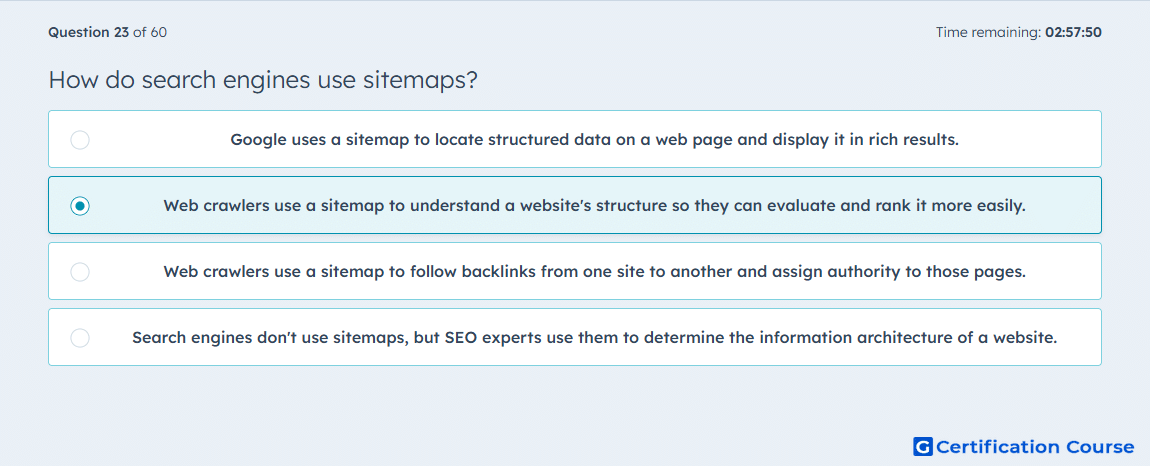
Question: How do search engines use sitemaps?
- Google uses a sitemap to locate structured data on a web page and display it in rich results.
- Web crawlers use a sitemap to understand a website's structure so they can evaluate and rank it more easily.
- Web crawlers use a sitemap to follow backlinks from one site to another and assign authority to those pages.
- Search engines don't use sitemaps, but SEO experts use them to determine the information architecture of a website.
Explanation
A sitemap provides a structured list of all pages on a website, helping web crawlers discover and navigate content efficiently. It ensures that search engines can access important pages, improving crawlability and indexing. Sitemaps also highlight the hierarchy and relationships between pages, supporting better evaluation and ranking. Regularly updating sitemaps ensures new or updated content is recognized promptly.
Why the other options are incorrect
Google uses a sitemap to locate structured data is incorrect; structured data is read from the page itself, not the sitemap.
Web crawlers use a sitemap to follow backlinks is incorrect; sitemaps do not contain external link paths.
Search engines don't use sitemaps is incorrect because crawlers rely on sitemaps to efficiently discover pages.
Source for verification
https://knowledge.hubspot.com/seo/sitemapsturn3search4
The answer(s) to the question is highlighted in the BOLD text above. You can also find more questions and answers related to the exams on the "HubSpot SEO Certification Course" page.