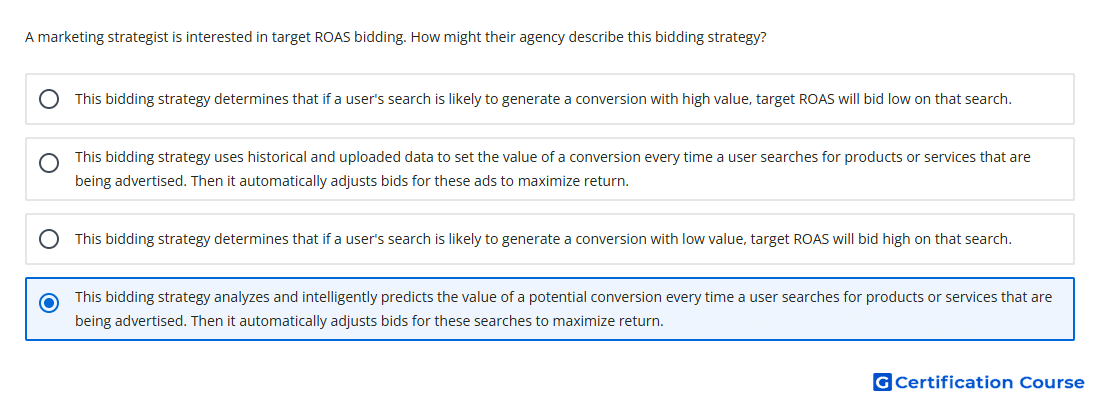
Question: A marketing strategist is interested in target ROAS bidding. How might their agency describe this bidding strategy?
- This bidding strategy uses historical and uploaded data to set the value of a conversion every time a user searches for products or services that are being advertised. Then it automatically adjusts bids for these ads to maximize return.
- This bidding strategy determines that if a user’s search is likely to generate a conversion with low value, target ROAS will bid high on that search.
- This bidding strategy analyzes and intelligently predicts the value of a potential conversion every time a user searches for products or services that are being advertised. Then it automatically adjusts bids for these searches to maximize return.
- This bidding strategy determines that if a user’s search is likely to generate a conversion with high value, target ROAS will bid low on that search.
or
- This bidding strategy uses historical and uploaded data to set the value of a conversion every time that a user searches for products or services that are being advertised. Then it automatically adjusts bids for these ads to maximise return.
- This bidding strategy analyses and intelligently predicts the value of a potential conversion every time that a user searches for products or services that are being advertised. Then it automatically adjusts bids for these searches to maximise return.
- This bidding strategy determines that if a user's search is likely to generate a conversion with low value, target ROAS will bid high on that search.
- This bidding strategy determines that if a user's search is likely to generate a conversion with high value, target ROAS will bid low on that search.
Explanation
Target ROAS is a Smart Bidding strategy that predicts the value of a potential conversion at each auction. It uses auction-time bidding to adjust bids based on the likelihood and expected value of the conversion. The goal is to help maximize conversion value while aiming for the advertiser’s target return on ad spend. This makes it appropriate for advertisers who assign values to conversions and want bidding optimized around return.
Why the other options are incorrect
Prompt label is not a bidding strategy description.
Low bid for high value reverses how value-based bidding responds to high expected conversion value.
High bid for low value reverses the intended bidding behavior for lower expected conversion value.
Historical and uploaded data is incomplete because Target ROAS predicts conversion value at auction time rather than only setting static values from past data.
Source for verification
https://support.google.com/google-ads/answer/6268637
The answer(s) to the question is highlighted in the BOLD text above. You can also find more questions and answers related to the exams on the "Google Ads - Measurement Certification" page.