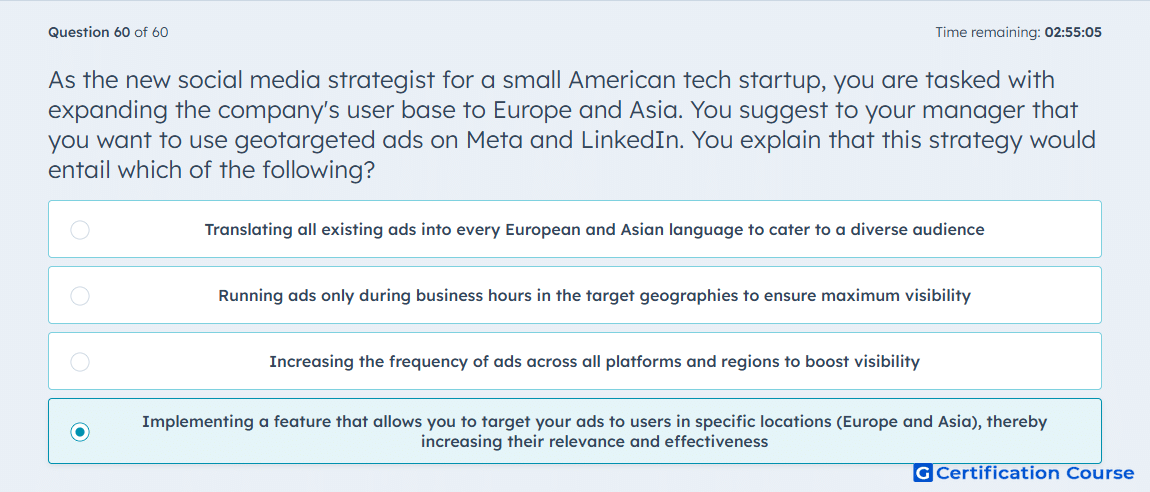
Question: As the new social media strategist for a small American tech startup, you are tasked with expanding the company's user base to Europe and Asia. You suggest to your manager that you want to use geotargeted ads on Meta and LinkedIn. You explain that this strategy would entail which of the following?
- Translating all existing ads into every European and Asian language to cater to a diverse audience
- Running ads only during business hours in the target geographies to ensure maximum visibility
- Increasing the frequency of ads across all platforms and regions to boost visibility
- Implementing a feature that allows you to target your ads to users in specific locations (Europe and Asia), thereby increasing their relevance and effectiveness
Explanation
Geotargeting means delivering ads to people based on specific geographic locations. In Amazon DSP, location signals can help advertisers reach relevant audiences across selected regions, markets, or local areas. This improves campaign relevance because messaging, language, offers, and timing can be adapted to where customers are located. Geographic targeting should still align with campaign goals, budget, and measurement strategy.
Why the other options are incorrect
Translating all ads is incorrect because geotargeting is about location-based delivery, not automatically translating every creative into every language.
Business hours only is incorrect because scheduling can support delivery, but it does not define geotargeting.
Increasing frequency is incorrect because frequency controls exposure volume, not location-based audience selection.
Source for verification
https://advertising.amazon.com/library/guides/local-tv-advertising
https://advertising.amazon.com/solutions/products/amazon-dsp
The answer(s) to the question is highlighted in the BOLD text above. You can also find more questions and answers related to the exams on the "Social Media Marketing Certification II" page.