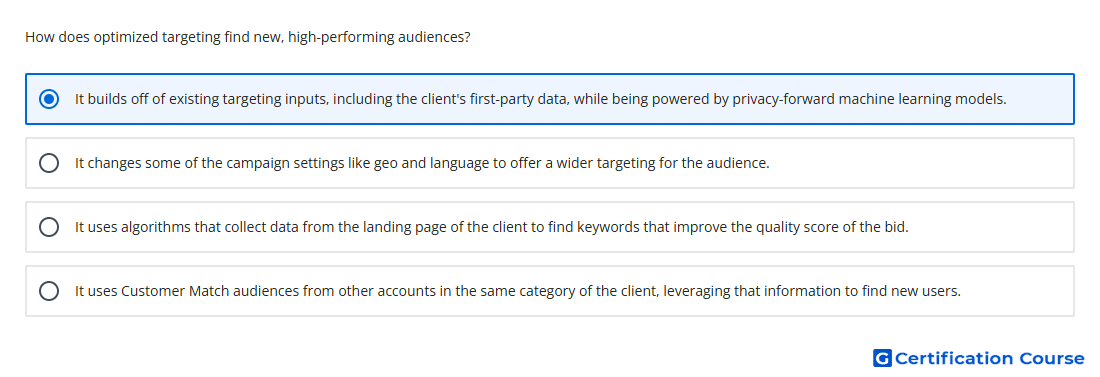
Question: How does optimized targeting find new, high-performing audiences?
- It builds off of existing targeting inputs, including the client's first-party data, while being powered by privacy-forward machine learning models.
- It uses algorithms that collect data from the landing page of the client to find keywords that improve the quality score of the bid.
- It uses Customer Match audiences from other accounts in the same category of the client, leveraging that information to find new users.
- It changes some of the campaign settings like geo and language to offer a wider targeting for the audience.
Explanation
Optimized targeting uses existing targeting inputs as signals to find additional people likely to convert. These inputs can include audience segments, keywords, landing pages, and first-party data. Google AI then looks beyond manually selected audiences to identify new, relevant users with stronger performance potential. This supports privacy-forward audience expansion without using another advertiser’s customer data.
Why the other options are incorrect
Customer Match from other accounts is incorrect because one advertiser’s Customer Match data is not used to target another advertiser’s users.
Landing page keyword collection is incorrect because optimized targeting is not designed to improve Quality Score through keyword extraction.
Geo and language settings is incorrect because optimized targeting does not expand audience performance by changing those campaign settings.
Source for verification
https://support.google.com/google-ads/answer/10537509
The answer(s) to the question is highlighted in the BOLD text above. You can also find more questions and answers related to the exams on the "Privacy for Agencies and Partners Certification" page.