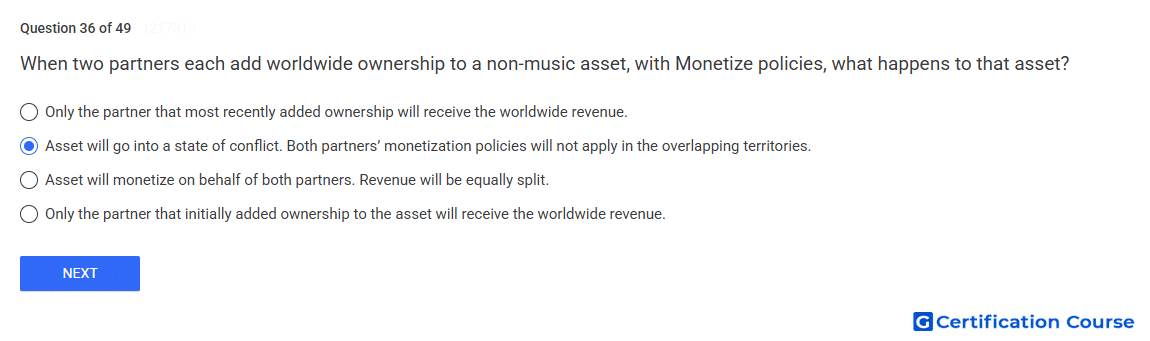
Question: When two partners each add worldwide ownership to a non-music asset, with Monetize policies, what happens to that asset?
- Only the partner that initially added ownership to the asset will receive the worldwide revenue.
- Only the partner that most recently added ownership will receive the worldwide revenue.
- Asset will monetize on behalf of both partners. Revenue will be equally split.
- Asset will go into a state of conflict. Both partners’ monetization policies will not apply in the overlapping territories.
Explanation
An asset ownership conflict occurs when multiple content owners claim ownership of the same non-music asset in the same territory. When worldwide ownership overlaps, YouTube cannot determine which owner’s monetization policy should control in those territories. As a result, the conflicting policies do not apply until the overlap is resolved. Ownership must be corrected so each territory reflects the valid rights holder.
Why the other options are incorrect
Initial owner revenue is incorrect because first ownership entry does not override a conflicting ownership claim.
Most recent owner revenue is incorrect because newer ownership does not automatically replace existing ownership.
Equal revenue split is incorrect because conflicting non-music ownership does not automatically create shared monetization.
Source for verification
https://support.google.com/youtube/answer/6303378
https://support.google.com/youtube/answer/3011552
The answer(s) to the question is highlighted in the BOLD text above. You can also find more questions and answers related to the exams on the "YouTube Content Ownership" page.