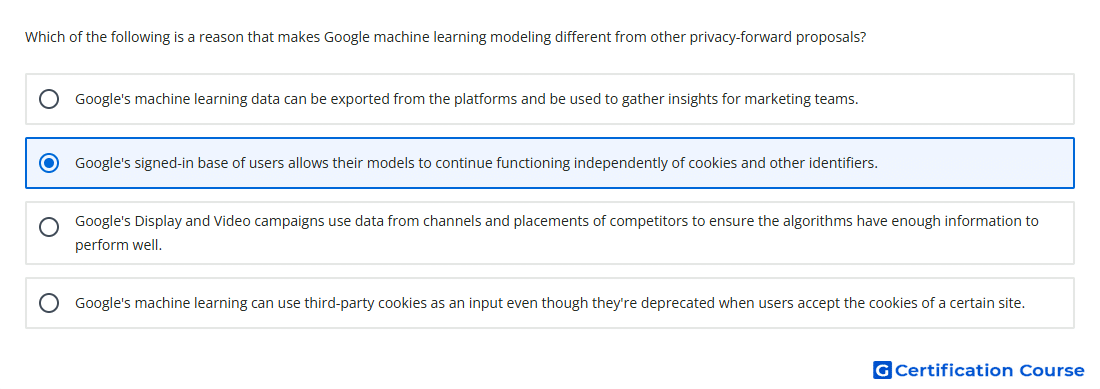
Question: Which of the following is a reason that makes Google machine learning modeling different from other privacy-forward proposals?
- Google's machine learning can use third-party cookies as an input even though they're deprecated when users accept the cookies of a certain site.
- Google's Display and Video campaigns use data from channels and placements of competitors to ensure the algorithms have enough information to perform well.
- Google's signed-in base of users allows their models to continue functioning independently of cookies and other identifiers.
- Google's machine learning data can be exported from the platforms and be used to gather insights for marketing teams.
Explanation
Google AI modeling uses observable, consented signals to estimate performance when some paths cannot be directly measured. Google’s scale across signed-in experiences gives its models durable signal coverage beyond third-party cookie availability. Conversion modeling can help close measurement gaps without identifying individual users. This makes Google’s modeling approach more resilient than proposals that depend mainly on alternative identifiers.
Why the other options are incorrect
Third-party cookies is incorrect because Google privacy-forward modeling is not differentiated by continued use of deprecated third-party cookie inputs.
Exported machine learning data is incorrect because Google platform modeling is not designed to export underlying model data for external profiling.
Competitor channel data is incorrect because Google Ads optimization does not use competitor placement data to fuel an advertiser’s campaigns.
Source for verification
https://support.google.com/google-ads/answer/12443859
https://business.google.com/us/privacy/products/
The answer(s) to the question is highlighted in the BOLD text above. You can also find more questions and answers related to the exams on the "Privacy for Agencies and Partners Certification" page.