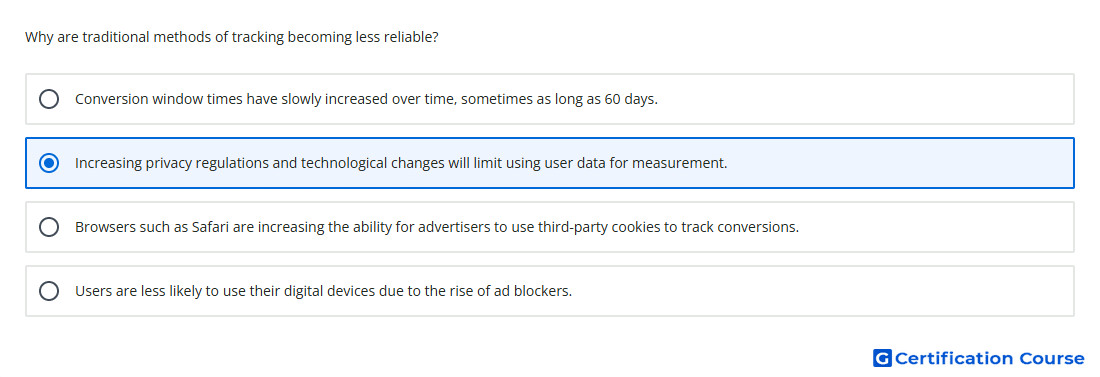
Question: Why are traditional methods of tracking becoming less reliable?
- Browsers such as Safari are increasing the ability for advertisers to use third-party cookies to track conversions.
- Users are less likely to use their digital devices due to the rise of ad blockers.
- Increasing privacy regulations and technological changes will limit using user data for measurement.
- Conversion window times have slowly increased over time, sometimes as long as 60 days.
Explanation
Privacy-centric changes reduce the availability of user-level signals used by traditional measurement. Third-party cookies and other identifiers are increasingly limited by browser changes, platform policies, and regulation. This creates gaps in observable conversion paths and makes deterministic tracking less dependable. Google privacy solutions such as Consent mode and conversion modeling help address these gaps without relying on unrestricted user-level tracking.
Why the other options are incorrect
Digital device usage is incorrect because ad blockers do not cause users to stop using devices.
Safari cookie expansion is incorrect because browsers have generally restricted, not expanded, third-party cookie tracking.
Conversion window times is incorrect because longer conversion windows do not explain why tracking signals are becoming less available.
Source for verification
https://support.google.com/google-ads/answer/10000067
https://support.google.com/google-ads/answer/9614122
The answer(s) to the question is highlighted in the BOLD text above. You can also find more questions and answers related to the exams on the "Privacy for Agencies and Partners Certification" page.