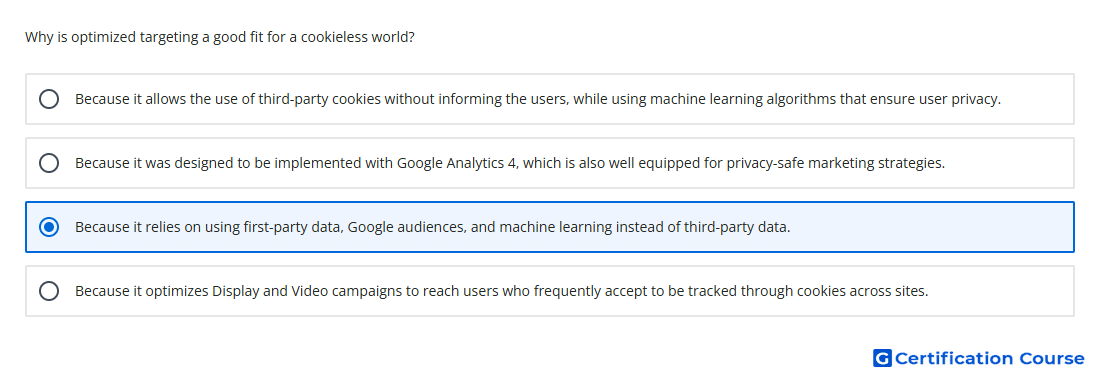
Question: Why is optimized targeting a good fit for a cookieless world?
- Because it relies on using first-party data, Google audiences, and machine learning instead of third-party data.
- Because it optimizes Display and Video campaigns to reach users who frequently accept to be tracked through cookies across sites.
- Because it was designed to be implemented with Google Analytics 4, which is also well equipped for privacy-safe marketing strategies.
- Because it allows the use of third-party cookies without informing the users, while using machine learning algorithms that ensure user privacy.
Explanation
Optimized targeting is designed to find additional converting users by using available campaign signals instead of relying on third-party data. It can build from first-party data, Google audience signals, keywords, and landing page inputs. Google AI then identifies new users likely to convert beyond manually selected audience segments. This makes the approach more durable as third-party cookie availability declines.
Why the other options are incorrect
Google Analytics 4 implementation is incorrect because optimized targeting does not depend on Google Analytics 4 as its required implementation method.
Cookie-based tracking acceptance is incorrect because optimized targeting is not based on finding users who accept cross-site cookie tracking.
Third-party cookies without notice is incorrect because privacy-safe Google solutions do not allow undisclosed third-party cookie use.
Source for verification
https://support.google.com/google-ads/answer/10537509
https://support.google.com/google-ads/answer/2497941
The answer(s) to the question is highlighted in the BOLD text above. You can also find more questions and answers related to the exams on the "Privacy for Agencies and Partners Certification" page.