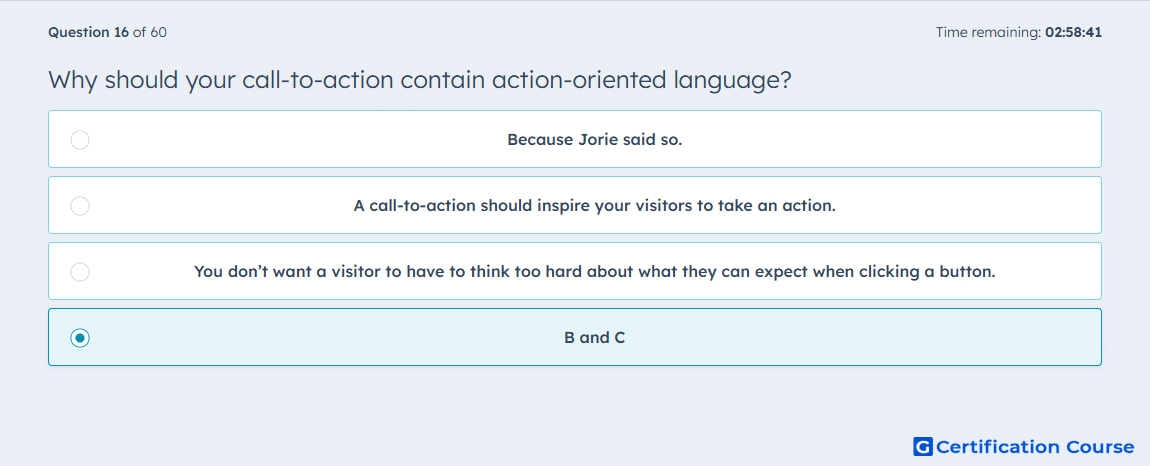
Question: Why should your call-to-action contain action-oriented language?
- Because Jorie said so.
- A call-to-action should inspire your visitors to take an action.
- You don’t want a visitor to have to think too hard about what they can expect when clicking a button.
- B and C
Explanation
A call-to-action (CTA) in HubSpot is a button or hyperlink used to drive visitors to a defined next step and track clicks. HubSpot also lets a CTA send visitors to a page, file download, meeting link, email address, external URL, or another CTA, so the text should clearly indicate what happens after the click. Clear, action-oriented wording reduces friction because visitors do not have to guess the outcome of clicking. That is why effective CTA language both encourages action and sets an immediate expectation for the next step. HubSpot Knowledge Base+3HubSpot Knowledge Base+3HubSpot Knowledge Base+3
Why the other options are incorrect
A) This is not a HubSpot product principle and does not describe how a CTA functions. HubSpot Knowledge Base+1
B) This is incomplete because it explains motivation to click but not the need to make the next step clear. HubSpot Knowledge Base+2HubSpot Knowledge Base+2
C) This is incomplete because clarity matters, but a CTA is also designed to actively drive the visitor toward an action. HubSpot Knowledge Base+1
Source for verification
https://knowledge.hubspot.com/ctas/create-calls-to-action
https://knowledge.hubspot.com/get-started/hubspot-glossary
The answer(s) to the question is highlighted in the BOLD text above. You can also find more questions and answers related to the exams on the "HubSpot Marketing Hub Software Certification" page.